
To write a dissertation proposal, choose a narrow topic, state one clear research question, show the gap in existing research, explain how you will answer the question, flag any ethics issues, and give a realistic timeline. Most proposals include a title, background, question and aims, a short literature review, a method plan, a timeline and references. Requirements vary by department, so always follow your own template.
A proposal is the first big test of your project, and it is the step that decides whether you may begin. If you are still getting oriented, our guide to how to write a dissertation shows where the proposal fits in the whole journey. This post goes deeper on the proposal itself: what each section does, how much detail to give, and why proposals get sent back.
Many students struggle with the same things. They are unsure how much detail to include, their topic is too broad, or their department’s format looks nothing like the examples they find online. You will find a fix for each of those below, plus an original annotated example you can model your own on.
What a Dissertation Proposal Is and What It Must Prove
A dissertation proposal is a short document that explains what you want to study, how you will study it, and why it needs studying. The University of Vermont Graduate Writing Center describes proposals as a way to justify and plan a research project, show how it fits existing research, and demonstrate that you can complete it in a reasonable time. Think of it as a contract between you and your department.
That description gives the proposal three jobs. It must justify the project by showing why the question matters. It must plan the project by explaining the method, ethics and timeline. And it must prove that you can finish, which is about scope and time more than ambition. Proposals that fail usually fail on the third job. The idea is interesting, but nobody believes it can be done in the time available.
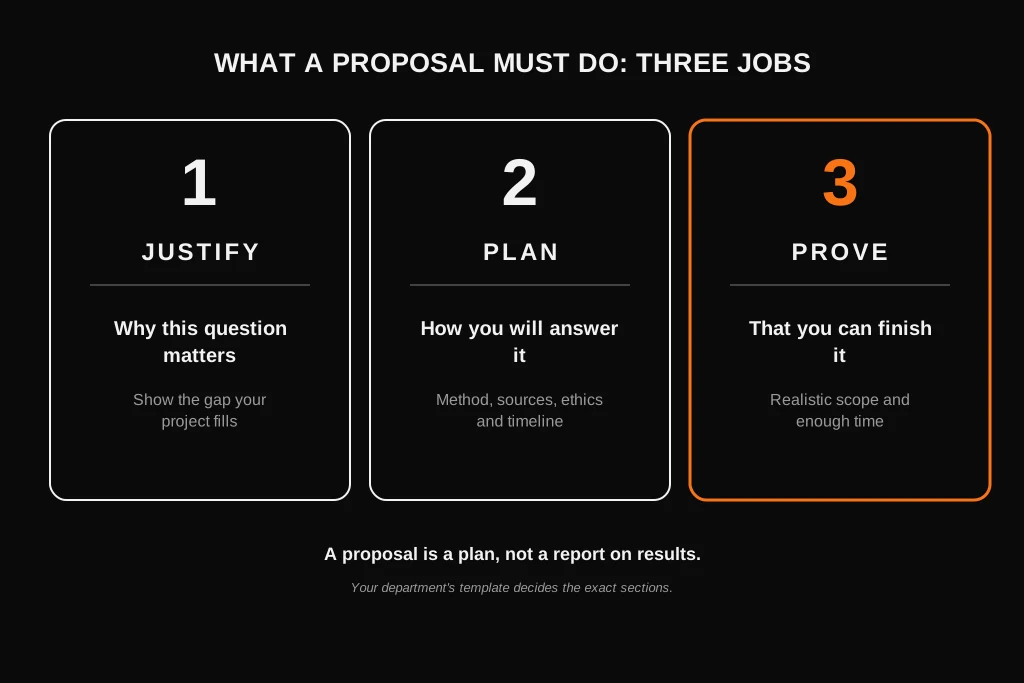
It also helps to remember what a proposal is not. It is not a short version of the dissertation, and it does not report results. It does not need every source you will ever read. It is a plan, and your committee reads it to decide whether the plan is sound. Committee members are usually reading several proposals at once, so clear headings, short paragraphs and a tight question help your plan stand out for the right reasons. If a reader can state your question and method after one read, the proposal is doing its job.
Before You Write: Topic, Feasibility and Your Supervisor
How to Choose a Dissertation Topic
A dissertation topic is a narrow, researchable question inside a subject you can stay interested in for months. It is the step that comes before the proposal, and a weak topic makes every later section harder. Good topics are specific, supported by existing research and possible to study within your limits.
Start from modules you enjoyed or assignments where you did well. Read a few recent articles or past dissertations in the area, and note where authors say more work is needed. Those remarks are often the seeds of a good question. Then narrow until you could answer the question in your word limit.
Tip: Write three possible questions in one sentence each, then run each through the feasibility test below.
The Four-Question Feasibility Test
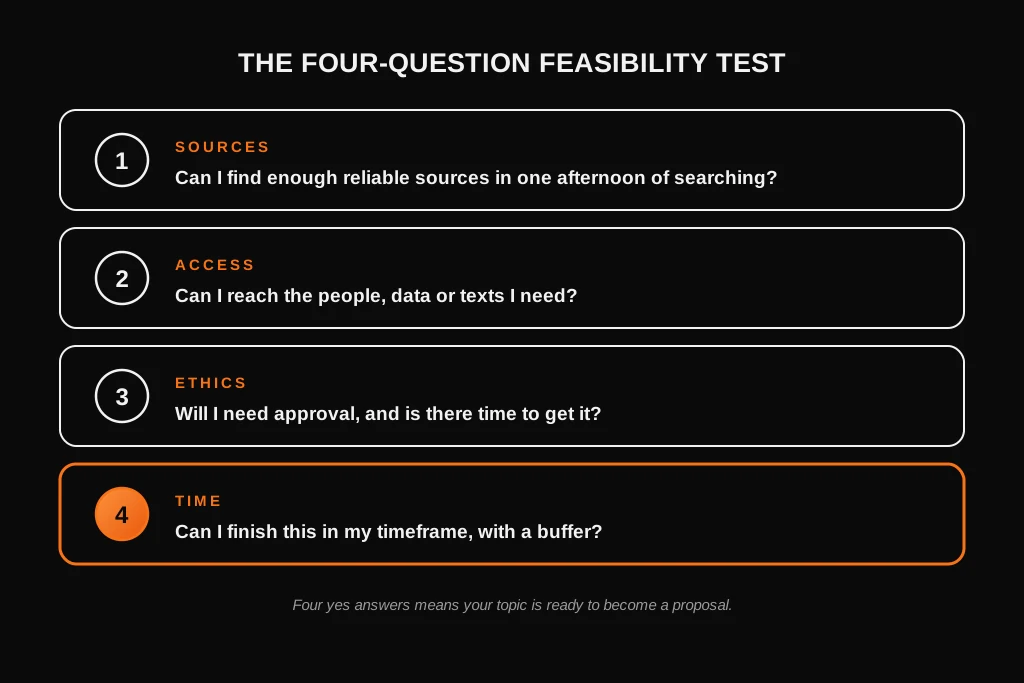
Before you invest weeks in a proposal, check that the project can actually be done. Answer these four questions honestly:
- Sources: can I find enough reliable sources in one afternoon of searching?
- Access: can I reach the people, data or texts I need?
- Ethics: will I need approval, and is there time to get it?
- Time: can I finish this in my timeframe, with a buffer week?
Four yes answers mean the topic is ready. A no is not a failure. It is a signal to narrow the scope or change the method now, when changing costs almost nothing.
Get Your Supervisor on Side Early
Your supervisor knows what your department will approve. Ask early whether there is a required template, whether you can see a recent successful proposal, and how detailed the method section should be. A five-minute conversation can save you a rewrite, and it shows that you take the process seriously.
The Parts of a Dissertation Proposal
Proposals are program specific, so the names and order below will differ from yours. The University of Vermont guide lists common sections including a title, background, aims or research questions, a literature review, methodology, and a timeline, and advises checking with your advisor and reviewing recent successful proposals. Use the sections below as a checklist, then match them to your department’s official template.
Title
A working title tells the reader your topic and the type of study. It does not have to be final. A clear, plain title such as “Short-Form Video and Study Habits: A Mixed-Methods Study of First-Year Students” is better than a clever one, because it signals your scope straight away.
Background and Rationale: The Dissertation Introduction in Miniature
This section introduces the problem, gives the minimum background a reader needs and explains why the question deserves an answer. In the final project it grows into a full chapter, but in a proposal it is usually a page or two. State the gap clearly and early.
Keep the background brief and focused. If you find yourself explaining the history of a whole field, you are writing too much. Aim to move from the broad topic to your specific problem in a few paragraphs.
Tip: Finish the section with one sentence that begins “This project addresses the gap by…”. It gives the reader a clean handover to your question.
Research Question, Aims, Objectives and Hypothesis
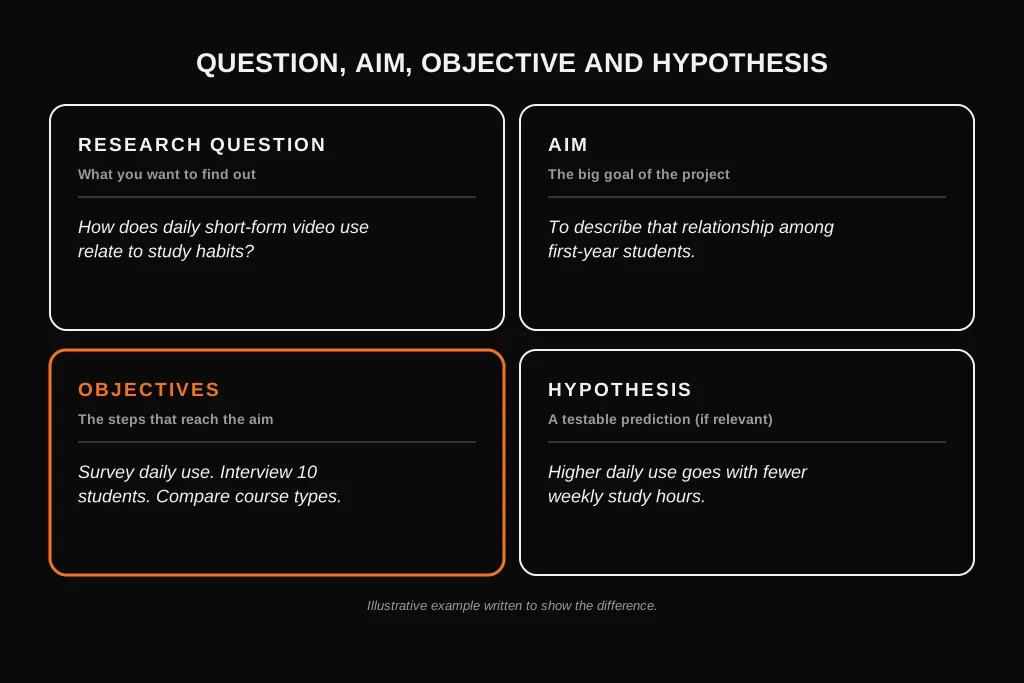
Students often mix these up, and examiners notice. The University of Portsmouth library explains that the question defines what you will investigate, the aim states what you hope to achieve, and the objectives break the aim into steps. A hypothesis is a testable prediction and is used mainly in quantitative work. The table shows the difference with a short example.
| Part | What it does | Example |
| Research question | Defines what you want to find out | How does daily short-form video use relate to the study habits of first-year students? |
| Aim | States the overall goal | To describe the relationship between daily use and reported study habits |
| Objectives | Break the aim into steps | Survey daily use; interview 10 students; compare course types |
| Hypothesis | Makes a testable prediction (if relevant) | Higher daily use is associated with fewer weekly study hours |
Dissertation Literature Review in a Proposal
A literature review is a critical survey of existing research that ends by showing the gap your project fills. In a proposal it is much shorter than the final chapter. You only need the main themes, the key debates and the limits of past studies, enough to show that you know the area and can justify your project.
Group sources by theme, compare them, and end with the gap. Do not try to read everything before you write. A focused set of strong, recent sources is better than a long list you have only skimmed. The full review comes later, once your proposal is approved.
Tip: Keep a note of your search terms and databases now. You will be asked for them later.
Dissertation Methodology in a Proposal
The method section explains how you will carry out the research and why that approach fits your question. In a proposal it works as a plan, not a report, so you describe what you intend to do. Cover your approach, your sample or sources, how you will collect data, how you will analyze it and what limits you expect.
How much detail depends on your department. Science and social science proposals usually describe participants, instruments and analysis. Humanities proposals often explain the texts, the theoretical lens and the method of reading. In every case, justify your choice by saying why it suits your question better than the alternatives.
Tip: Match each objective to one method step. If an objective has no matching step, the plan has a hole.
Ethics and Risk
If your project involves people, you will usually need ethical approval before collecting any data. The Portsmouth guidance says to address consent, confidentiality and the right to withdraw and to get approval first. Even a text-based project may need a short note about sensitive material or data storage.
Mention ethics in the proposal even if approval comes later. It shows that you have thought about participants and risk, and it reassures the committee that the timeline allows for approval.
Timeline
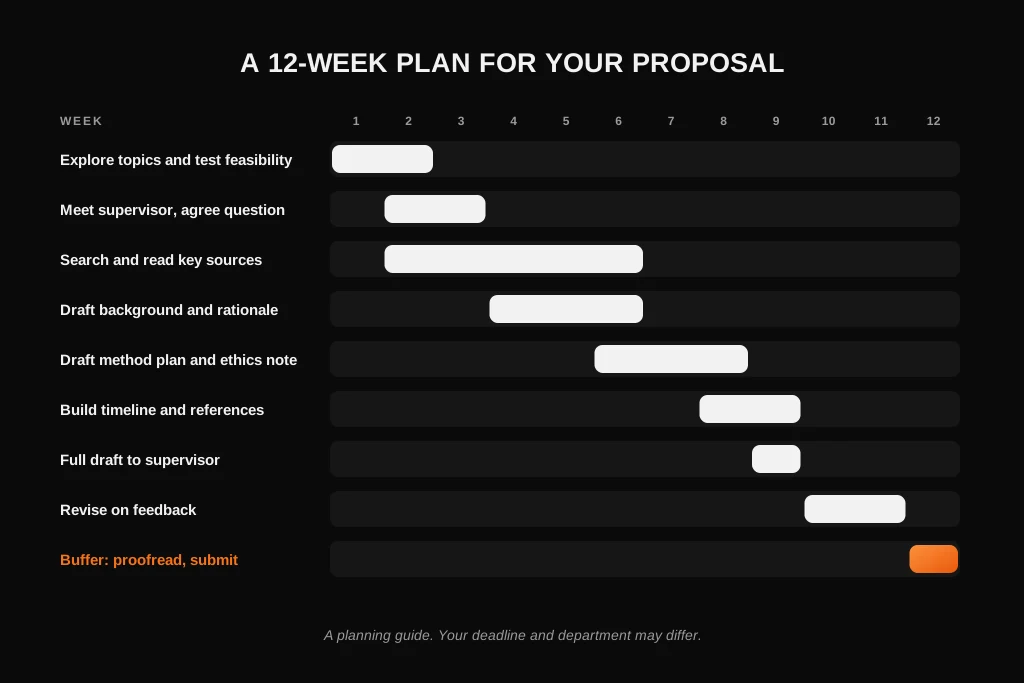
A timeline is where the committee judges feasibility. List the main stages of the research, assign each a rough length and leave space for revision. A simple table is enough. Include a buffer, because ethics approval, access to participants and feedback almost always take longer than planned.
| Weeks | Stage | Output |
| 1 to 2 | Explore topics and test feasibility | Shortlist of questions |
| 2 to 3 | Meet supervisor and agree the question | Agreed question |
| 2 to 6 | Search and read key sources | Source notes |
| 4 to 6 | Draft background and rationale | Section draft |
| 6 to 8 | Draft method plan and ethics note | Method section |
| 8 to 9 | Build timeline and reference list | Complete draft |
| 10 to 11 | Revise on supervisor feedback | Final draft |
| 12 | Buffer: proofread and submit | Submitted |
This 12-week schedule is for writing the proposal itself, not the dissertation. Treat it as a planning guide and adjust it to your own deadline.
Expected Outcomes and the Dissertation Conclusion
A proposal does not have a conclusion in the way the final dissertation does, because you have no results yet. What many departments ask for instead is a short statement of expected outcomes and significance. Say what you expect to find or contribute, and be honest about what could change.
The final chapter comes at the very end of the finished project, where it answers the question, summarizes the findings and states the limits. Writing your expected outcomes clearly now makes that final chapter easier, because you can compare what you predicted with what you found. Avoid overclaiming. Phrases such as “is expected to” and “may show” are honest and acceptable at this stage.
How to Write a Dissertation Abstract and Why Proposals Use Summaries
Some departments ask for a one-paragraph summary at the top of a proposal. It covers the problem, the question, the method and the expected contribution. The University of Vermont guide advises checking whether your advisor requires one. Keep it plain and specific, avoid undefined abbreviations and do not promise results you cannot yet report. The full abstract is a different document, written last, and summarizes the finished project and its findings.
A good summary reads on its own. A reader should learn the problem, your question, your approach and why it matters without opening the rest of the document, which is also how committee members often decide how closely to read the full plan.
Tip: Write any proposal summary after the rest of the draft, one sentence per section, then trim to the word limit.
References, Appendices and Dissertation Acknowledgements
List the key sources you have cited, in the style your department requires. Some proposals also include appendices, such as draft survey questions or an interview guide. Acknowledgements do not belong in a proposal. They are a short personal note of thanks that appears near the front of the finished dissertation, so save them until the end. When you do write them, thank your supervisor first, then participants, advisers and funders, and keep the tone warm and professional. If a funder or ethics committee requires specific wording, check that early, because it is much easier to plan for than to fix at the last minute.
From Proposal to Final Chapters
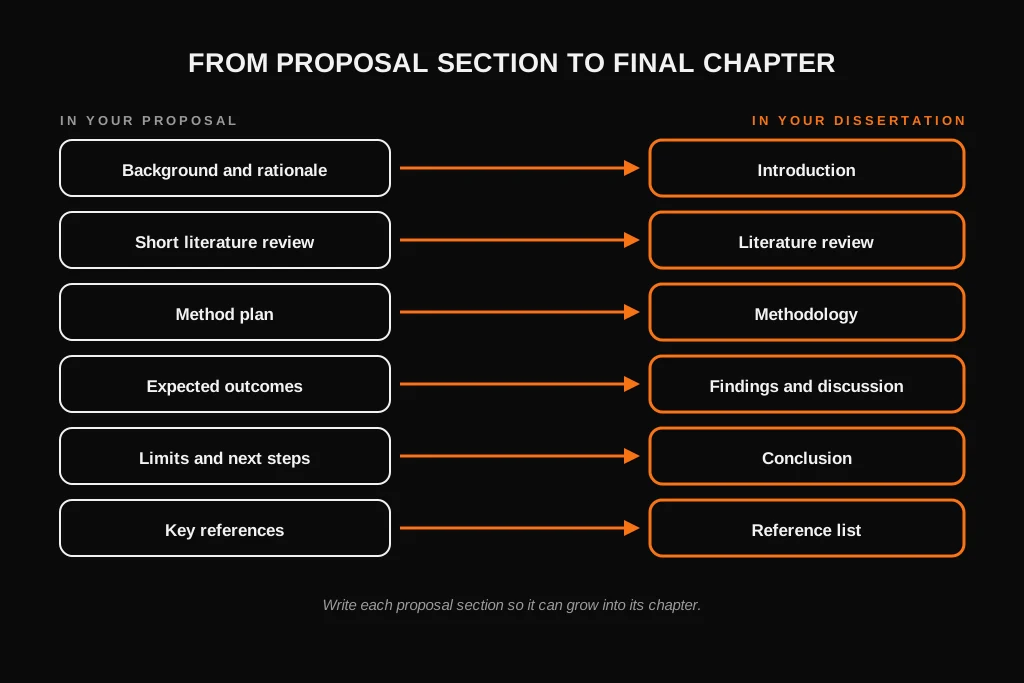
Each section of your proposal is a seed for a chapter. When you write it with that in mind, the later work becomes a matter of growing what you already have. This is also where it helps to understand the dissertation structure you are aiming for, because it shows what each proposal section will become.
| In your proposal | Becomes this chapter | What changes |
| Background and rationale | Introduction | Grows from a page or two into a full chapter |
| Short literature review | Literature review | Expands into a critical survey of the field |
| Method plan | Methodology | Future tense becomes past tense, with full detail |
| Expected outcomes | Findings and discussion | Predictions are replaced by real results |
| Limits and next steps | Conclusion | Becomes a full answer to the question |
| Key references | Reference list | Grows to every source you cited |
Do not worry if the final dissertation drifts from the proposal. Many do. Departments generally treat an approved proposal as a plan, not a binding promise. Just tell your supervisor about any major change.
Length, Timing and Level
How Long Should a Dissertation Be?
Your proposal should state the planned word count, so find your limit first. Commonly cited ranges are roughly 8,000 to 15,000 words for undergraduates, 12,000 to 50,000 for master’s students and 70,000 to 100,000 for doctoral dissertations, though this varies by university and field. One UK university’s dissertation handbook describes a 30-credit undergraduate dissertation as broadly an 8,000 to 10,000 word project and notes that the count normally excludes reference lists and appendices.
The proposal itself is much shorter than the dissertation. Doctoral proposals in some programs run to a few dozen pages, while a taught master’s proposal may be only a few pages or a couple of thousand words. Check the limit in your handbook.
How Long Does It Take to Write a Dissertation Proposal?
Most students need several weeks, not days. Finding a topic, reading enough to see the gap, getting feedback and revising all take time, and many departments also need time to approve it. The 12-week plan above is a safe pattern for an undergraduate or master’s student, while doctoral students often take longer because their proposals are longer and more detailed. Work backwards from your submission date, protect the buffer week, and book your supervisor meetings early, because supervisors fill their calendars quickly near deadlines. A common mistake is to spend most of the time reading and leave only a few days for writing, so schedule drafting alongside reading from the start.
Undergraduate vs Masters Dissertation Proposals
An undergraduate proposal shows that you can plan a small, guided project. It is usually shorter, with a focused review and a simple method. A master’s proposal expects a clearer gap, a more developed method and more independence. If you are learning how to write a masters dissertation proposal, plan extra time for the literature and method sections. Doctoral proposals go further again, with a full critical map of the field and a clear original contribution. Ask for your department’s marking criteria for your level, and write the proposal against those descriptors. The difference is rarely in the section headings. It is in how far you justify the gap, defend the method and show independence.
Dissertation vs Thesis, and Why Some Departments Say Prospectus
The words dissertation and thesis swap meaning between countries. According to the University of Essex library, the UK usually uses dissertation for undergraduate and taught master’s work and thesis for doctoral research, and the US is the reverse. Some departments, especially for doctoral work, call the proposal a prospectus. The University of Massachusetts economics department describes a prospectus as a plan for the dissertation, not a report on results, and gives example lengths of around 20 to 30 pages. Use whichever term your department uses, and check whether the proposal is a separate assessed task or a formal gate you must pass before you start.
Dissertation Proposals by Field
The core of a proposal stays the same across fields, but the emphasis changes. A few quick pointers:
- Sciences: expect more detail on design, materials, measures and analysis, and a clearer hypothesis.
- Social sciences and psychology: expect a strong rationale, a justified sample and a clear ethics section, especially when you involve participants.
- Law: expect a clear legal question, the sources of law you will analyze and the approach you will take, such as doctrinal or comparative.
- Humanities: expect a central argument, the texts you will read, the theoretical lens and a chapter plan rather than data collection.
Whatever your field, review one or two recent approved proposals from your own program. They show the level of detail your committee expects better than any general guide.
Writing Style: Tone, Tense and Citations
Proposals have a slightly different voice from finished dissertations. You are describing a plan, so use future tense for what you will do, present tense for the problem and the field, and past tense when you report what earlier researchers found. Keeping those three tenses straight makes your plan easier to follow and signals that you understand the genre.
Write in plain, confident language. Avoid vague claims like “many people believe” and name your sources instead. Define any technical term the first time you use it, and keep sentences short enough that a reader from a nearby field can follow them. Use one citation style from start to finish, because switching styles mid-proposal looks careless and creates extra work later.
An Annotated Mini Proposal
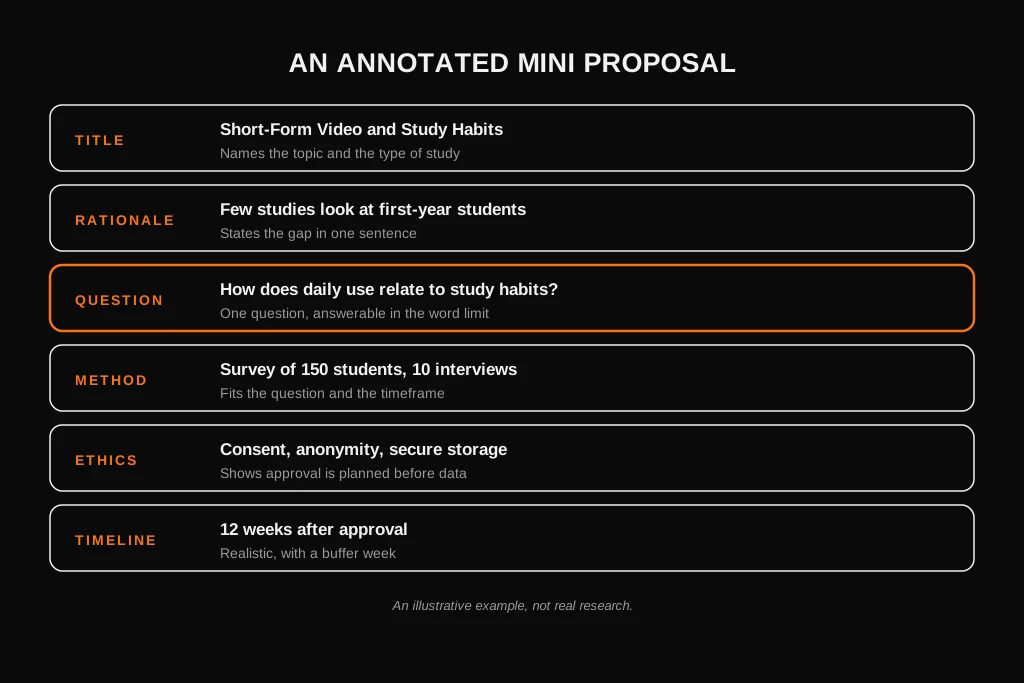
The example below was written for this post to show the parts working together. Its claims are illustrative, not research findings, and it is not based on any real proposal. Use it as a model of shape, not content.
Title: Short-Form Video and Study Habits: A Mixed-Methods Study of First-Year Students
Rationale: Short-form video apps are now part of daily student life, yet little work looks specifically at how they relate to the study habits of first-year students in their first term. This project addresses that gap. (Why it works: it states the gap in one sentence.)
Research question: How does daily short-form video use relate to the weekly study habits of first-year undergraduates at one university? (Why it works: one question, narrow enough to answer in the word limit.)
Aim and objectives: To describe the relationship between daily use and reported study habits by surveying use, interviewing students and comparing course types. (Why it works: objectives are steps that reach the aim.)
Method: A survey of about 150 first-year students and 10 follow-up interviews, analyzed with descriptive statistics and thematic analysis. (Why it works: each method matches an objective.)
Ethics: Informed consent, anonymity and secure data storage, with approval sought before any data is collected. (Why it works: it shows approval is planned before data collection.)
Timeline: Twelve weeks after approval, including a buffer week for transcription and analysis. (Why it works: realistic, with room for delay.)
Real Problems Students Face With Proposals
“My department’s format looks nothing like the online examples.” This is normal, and your department wins. General guides describe common sections. Your handbook and a recent approved proposal describe what you are marked against. Use guides to understand why a section exists, and your department to decide how to arrange it.
“My topic keeps getting bigger.” Return to the feasibility test. Narrow by population, place, time period or one specific aspect of the problem until you could finish it in the time you have.
“I do not know how much detail to give.” Match the detail to the decision. The committee needs enough to judge whether the plan is sound, not a full report. If in doubt, ask your supervisor for a recent approved example and compare lengths.
“My supervisor is slow to reply.” Send a short, specific email with a date, as in the script below, and name the two or three questions you most need answered. If the delay continues, ask your department who else can give you an early read.
Why Proposals Get Sent Back, and How to Fix Them
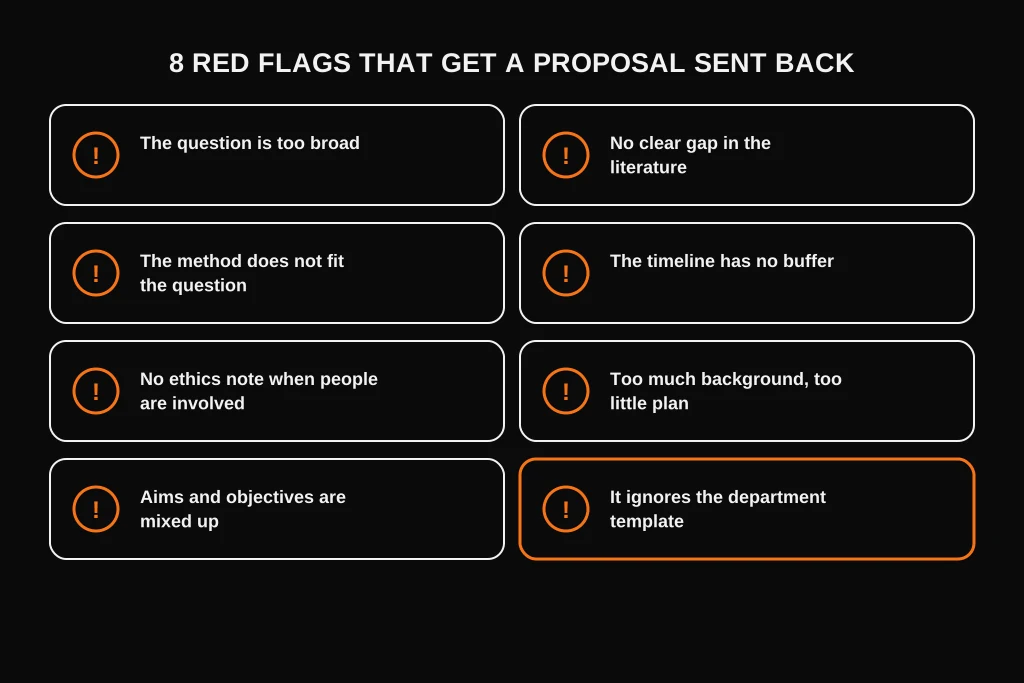
Being asked to revise a proposal is common and is not a sign of failure. These eight problems account for most requests. Run your draft through the list before you submit.
- The question is too broad. Narrow it until you could answer it in your word limit.
- There is no clear gap in the literature. Add one sentence naming what is missing.
- The method does not fit the question. Match each objective to one method step.
- The timeline has no buffer. Add a week for approval, feedback and delays.
- There is no ethics note where people are involved. State consent, privacy and approval.
- There is too much background and too little plan. Cut history and expand the method.
- Aims and objectives are mixed up. Keep the aim as the goal and the objectives as the steps.
- The proposal ignores the department template. Follow your own handbook first.
Ask Your Supervisor for Feedback: A Short Email Script
Feedback on a draft is the most useful thing you can get, and a short, polite email makes it easy to give. Our guide on how to write a dissertation includes a longer list of questions for supervisor meetings, but this message is enough to get started:
Subject: Draft dissertation proposal for feedback
Dear Dr. [Name], I have attached a draft of my dissertation proposal on [topic]. I would be grateful for your feedback on whether the research question is the right size and whether the method is realistic for my timeline. I have also noted where I am unsure about the ethics section. Could we meet or exchange comments before [date]? Thank you for your time. Best wishes, [Your name]
Keep it short, give a date, and name the two or three things you most want help with. Supervisors respond faster when the request is specific.
How EssaysHelper Can Help You
Writing a proposal can feel like guessing what your committee wants. EssaysHelper can support you at each point without taking over your work:
- Reviewing your question, aims and objectives for clarity and scope.
- Giving feedback on your literature review and method plan.
- Helping you build a realistic timeline from your deadline.
- Editing drafts for clarity, flow and consistent formatting.
If you are stuck on a specific section, send us your question and your deadline and we will point you to the quickest next step.
Frequently Asked Questions
How do I start writing a dissertation proposal?
Start with your topic and one clear question. Test it with the feasibility check, talk to your supervisor, and then draft the background and method. Write the summary and background sections last so they match the plan you end up with.
How long should a dissertation proposal be?
It depends on your level and department. Undergraduate and taught master’s proposals are often a few pages or a couple of thousand words, while doctoral proposals can run to a few dozen pages. Check your handbook for the exact limit.
How long does it take to write a dissertation proposal?
Most students need several weeks. A 12-week plan with a buffer works for many undergraduate and master’s students, and doctoral proposals often take longer. Start early, because feedback and approval add time.
What should a dissertation proposal include?
Most include a title, background and rationale, a research question with aims, a short literature review, a method plan, ethics, a timeline and references. Some add a summary or chapter plan. Your department’s template decides the exact list.
What is the difference between a dissertation proposal and a prospectus?
They are usually the same thing. Some departments, especially for doctoral work, use prospectus for the plan that gets a dissertation approved. Use the term your department uses and follow its template.
Can I write a good dissertation proposal without finished reading?
Yes. A proposal needs the main themes and gaps, not every source. Read enough to justify your question, then note what you still plan to read. The full review comes after approval.
Do I need an ethics section in my dissertation proposal?
If you involve people, yes, and approval is usually needed before you collect data. Even other projects may need a note about sensitive material or data storage. Ask your department what applies.
How do I write a research proposal for a dissertation in a short time?
Cut the scope first. Use one question, one method and a short timeline, and ask your supervisor for a quick check on the question. Do not skip the feasibility test, because it prevents the biggest problems.
Can I change my dissertation after the proposal is approved?
Yes, within reason. Many dissertations shift as the research develops. Tell your supervisor about major changes, and make sure the research question still runs through every chapter.
Is a proposal different for a masters and a PhD?
Yes. A master’s proposal is shorter and expects a clear gap and sound method. A PhD or doctoral proposal is usually longer, with a fuller review of the field and a clear original contribution.
Final Thoughts
Learning how to write a dissertation proposal comes down to a few habits: choose a narrow question, test whether it is feasible, show the gap, plan the method honestly and build in a buffer. A good proposal is not a promise to know everything. It is a convincing plan that shows you can finish. Write one section at a time, use your department’s template as the final check, and ask your supervisor for feedback early. When a section feels stuck, return to your research question and ask what that section owes it.