
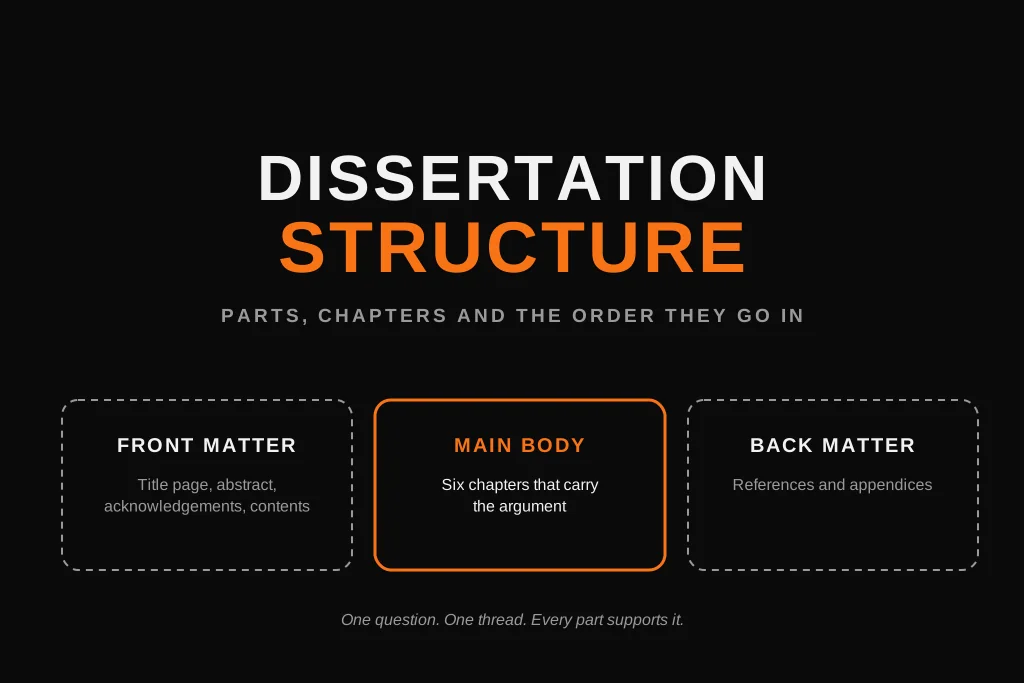
Dissertation structure is the order of sections that guides a reader from your research question to your answer. Most dissertations have three zones: front matter (title page, abstract, acknowledgements and contents), a main body (introduction, literature review, methodology, findings, discussion and conclusion) and back matter (references and appendices). Names and order vary by subject and university, so always check your department’s guidelines.
If you are still planning the whole project, start with our guide on how to write a dissertation, then come back here for the detail. This post focuses on one question students ask again and again: what exactly goes where, and why?
The honest answer is that structure is where many dissertations are won or lost. A strong idea in a confusing order reads like a weak idea. A clear order makes an average idea look careful. The good news is that structure is something you can plan, test and fix long before you write 10,000 words.
What Dissertation Structure Really Means
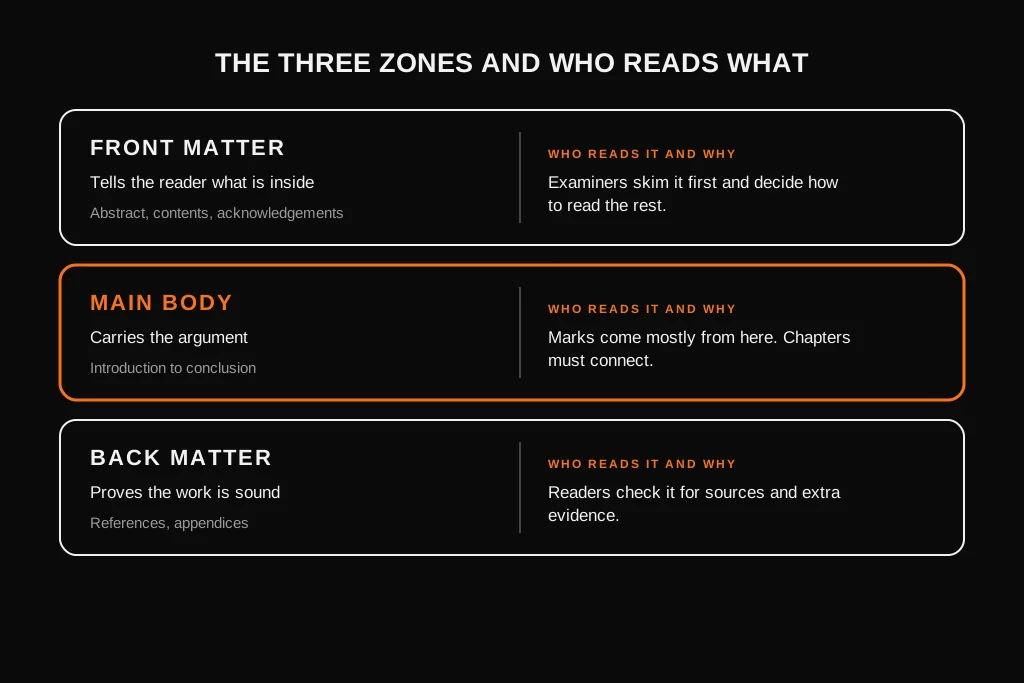
Think of your dissertation as a building with three zones. The front matter is the entrance. It tells the reader what is inside before they commit to reading. The main body is the building itself, where your argument lives. The back matter is the storeroom, where the proof is kept for anyone who wants to check it.
Each zone has a different reader. Examiners often skim the front matter first to decide how to read the rest. They spend most of their time and marks in the main body. They turn to the back matter when they want to check a source or a piece of evidence. Writing with those readers in mind makes your choices easier. The abstract has to be brief and complete, the chapters have to connect, and the references have to be exact.
One more point before the detail. There is no single correct structure. There are common models, and your department chooses among them. The sections below describe the usual version and show how it changes, so you can recognize your own.
Front Matter: What Comes Before the Argument
Front matter is everything that appears before your first chapter. It is short, but it creates the first impression, and it is often the last part you finish. A typical order is title page, abstract, acknowledgements, table of contents, then any lists of figures or tables.
How to Write a Dissertation Abstract
A dissertation abstract is a short summary of the whole project, usually one paragraph or one page, that lets a reader decide quickly whether to read on. In the structure it sits right after the title page. Good abstracts cover four things in order: the question, the method, the main findings and the conclusion. They leave out detailed citations, quotations and tables.
Because readers use the abstract to judge the whole project, every sentence has to earn its place. Use plain language, avoid undefined abbreviations and do not promise results you do not report. If your department asks for keywords, choose the terms a researcher would actually search for, and ask early what the maximum length is.
Tip: Write it last, one sentence per chapter, then trim to your department’s word limit. An abstract written early usually describes a project that no longer exists.
Dissertation Acknowledgements
The acknowledgements are a short, personal note thanking the people and organizations who helped you. They usually follow the abstract and sit outside the argument, so they are not marked like a chapter. Most students thank their supervisor first, then participants, advisers, funders and finally friends and family. Keep the tone warm but professional, because the page becomes part of a permanent record.
Write the acknowledgements last, when you remember who actually helped. Name people the way they would like to be named, double check spellings, and avoid private jokes that an examiner or future reader would not understand.
Tip: Check whether your funder or ethics approval requires formal wording, and keep the page to a single side.
Contents and Lists
The table of contents lists every heading with its page number, and any lists of tables or figures follow it. Treat the contents page as a quick test of your structure. If the headings read like a clear outline of your argument, the structure works. If they read like a random list, your chapters probably need renaming or reordering. Generate it automatically from your heading styles so it updates when you revise. If you include lists of tables and figures, check that every caption matches the number and title used in the text.
The Main Chapters: Where the Argument Lives
The main body is where most marks are earned. The University College Dublin Writing Centre suggests that each chapter should open by stating its task, develop its points with evidence and analysis, and close with a short summary and a link to the next chapter. Its guidance on master’s dissertation structure also reminds students to follow their own school’s rubric. That habit of opening, developing and handing over is what turns six chapters into one argument.
Dissertation Introduction
The dissertation introduction tells the reader what the project is about, why it matters and how the rest is organized. It states the research question, sets the scope, defines key terms and previews the chapters. It is the first chapter a reader sees, but in practice it is best finished near the end, when you know what you actually argued.
A good introduction usually moves in a simple order: the topic and why it matters, a short background, the gap or problem, the research question and aims, and finally a roadmap of the chapters. Keep the background brief. A full review of the research belongs in the next chapter, and putting it here is a common reason introductions run long.
Tip: Check that the research question appears in the same words in the introduction, the methodology and the conclusion.
Dissertation Literature Review
A dissertation literature review is a critical survey of existing research that ends by showing the gap your project fills. It sits straight after the introduction, because it explains why your question deserves an answer. It is organized by theme, not by author, and it compares studies rather than listing them. Its last paragraph should lead naturally into your method.
Treat the review as a conversation between sources, not a list of summaries. Say where researchers agree, where they disagree and where nobody has looked yet. Keep a record of your searches, the databases you used and the years you covered, because many departments expect you to show how you found your sources.
Tip: If your review ends without a clear gap, readers will wonder why your project exists. Add one sentence that names the gap and one that names your approach to it.
Dissertation Methodology
Your dissertation methodology explains how you did the research and why that approach fits your question. It follows the literature review, which usually shapes the choices you make here. It covers your approach, sample or sources, tools, analysis and any ethical steps, and it admits limitations. A reader should be able to judge whether your results can be trusted.
The level of detail depends on your field. Scientific and social science dissertations describe participants, instruments and statistical tests. Humanities dissertations may explain the theory, the texts and the analytical lens instead. If people are involved, explain consent, privacy and data storage, and ask whether ethics approval is needed before you collect anything.
Tip: Justify each decision against the alternatives you rejected. Saying why you did not choose another method shows you understand the field.
Findings and Discussion
In many fields these are two chapters with two jobs. The findings chapter reports what you found and stays factual. The discussion chapter interprets it, connects it back to the literature and answers your question. A University of Texas at San Antonio guide to the IMRaD structure describes the same split: results report what happened, and the discussion explains what it means. Some humanities and professional dissertations merge the two or replace them with thematic chapters, so confirm your own expectation.
Dissertation Conclusion
A dissertation conclusion answers the research question, summarizes the main findings and explains why they matter. It is the last chapter of the main body, and it should mirror the introduction so the reader feels the argument close. It also states the limits of the study and suggests realistic next steps. It does not introduce new evidence.
A strong conclusion also shows judgement. Say what the study could not do, whether because of sample size, time or access, and how that limit affects the answer. Offer one or two realistic next studies rather than a long wish list, and finish on your contribution rather than an apology.
Tip: Many readers go from the abstract straight to the conclusion, so make sure it makes sense on its own.
Back Matter: References and Appendices
Back matter holds what a reader may need to check but does not need to read in sequence. The reference list gives full details for every source you cited, in the style your department requires. Appendices hold supporting material that would interrupt the flow of a chapter, such as survey questions, interview guides, consent forms, extra tables or raw data samples.
A useful rule is that the main text must make sense without the appendices. If a reader has to flip to an appendix to follow your argument, move the key point into the chapter and leave the detail in the appendix. Also check whether your word count includes or excludes references and appendices, because many universities leave them out.
Reading Order vs Writing Order
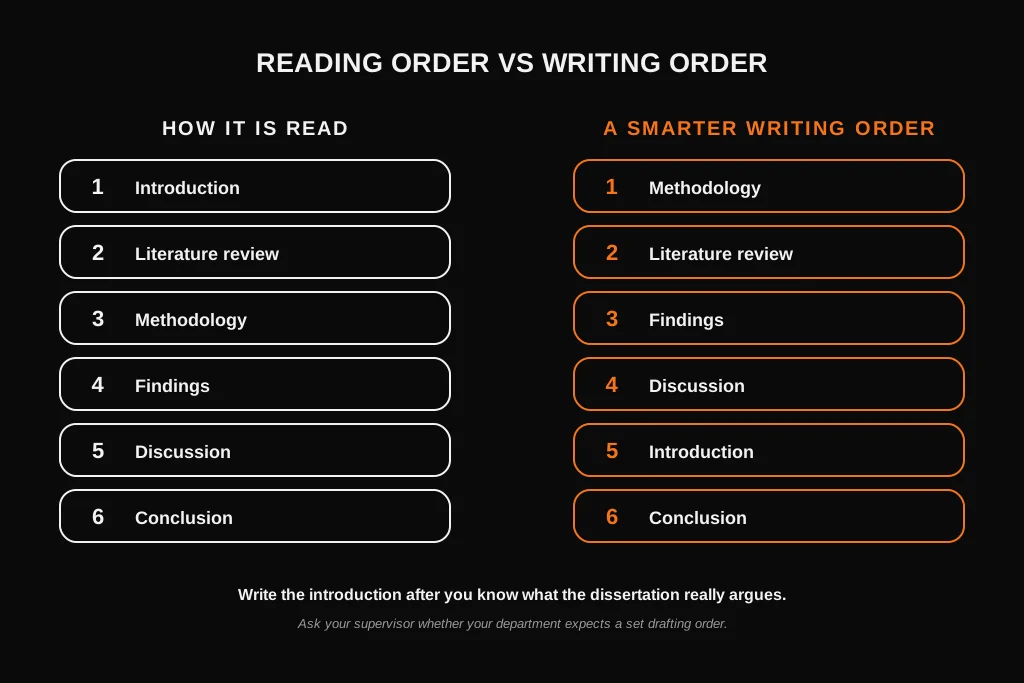
Here is something many guides skip. The order in which a dissertation is read is not the best order in which to write it. A reader meets the introduction first. A writer who starts there often has to rewrite it completely, because the project changes as the research progresses.
Many students find it smoother to draft the methodology while it is fresh, then the literature review, then the findings and discussion, and only then the introduction and conclusion. The table below shows the two orders side by side. Treat the writing order as a suggestion, and confirm with your supervisor if your department expects drafts in sequence.
| Reading order | Suggested writing order | Why the writing order helps |
| 1. Introduction | 1. Methodology | You remember exactly what you did while it is fresh |
| 2. Literature review | 2. Literature review | The gap becomes clearer once the method is fixed |
| 3. Methodology | 3. Findings | You report results before you interpret them |
| 4. Findings | 4. Discussion | You can now explain what the results mean |
| 5. Discussion | 5. Introduction | It now describes the project you actually completed |
| 6. Conclusion | 6. Conclusion and abstract | Both summarize a finished argument |
The Golden Thread: One Question Through Every Chapter
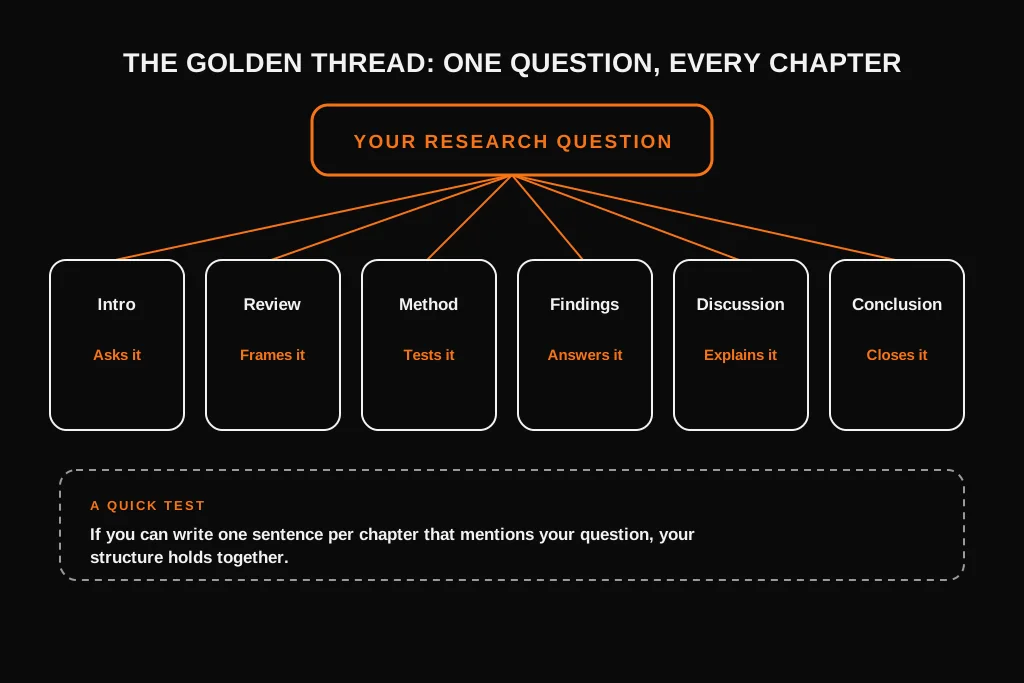
A dissertation holds together because of one thing: a single research question that every chapter serves. Think of it as a thread running through the whole document. The introduction asks it, the literature review frames it, the methodology tests it, the findings answer it, the discussion explains it and the conclusion closes it.
This gives you a quick test for your structure. Write one sentence per chapter that mentions your question. If you can, your structure holds. If one chapter has nothing to say about the question, it probably belongs elsewhere, needs rewriting or needs cutting. This test also helps with the most common complaint from examiners, which is chapters that feel like separate essays.
How Dissertation Structure Changes by Discipline
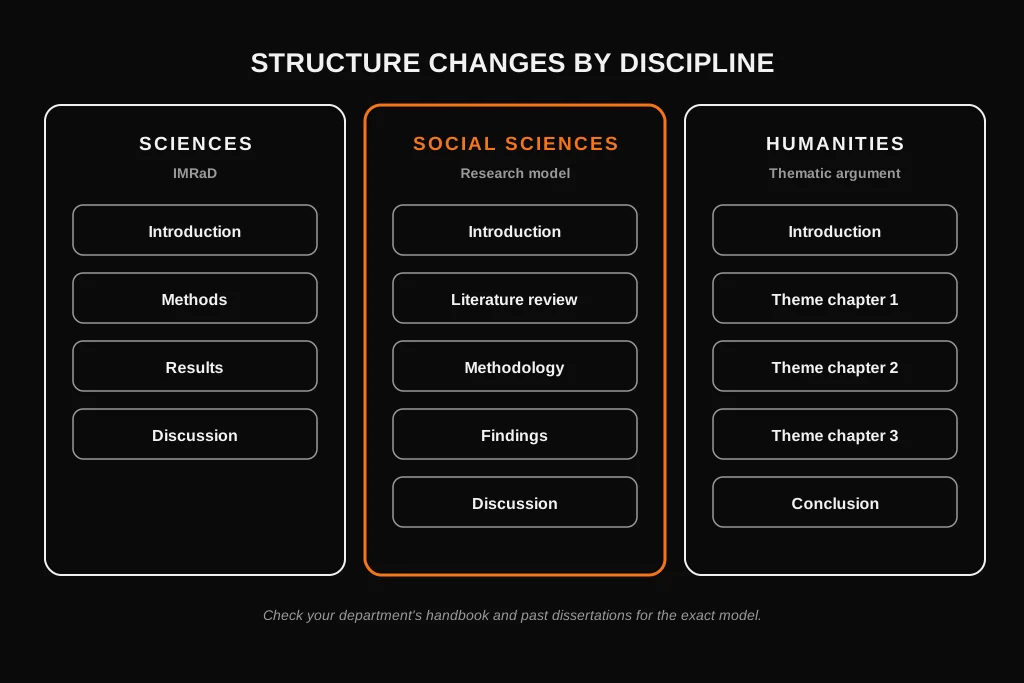
Different fields have different habits about how to present research. If you have read dissertations from another subject, you may have noticed that they look nothing like yours. That is normal, and you should follow your own field. Three broad models cover most cases.
| Model | Typical fields | Chapters | Main idea |
| IMRaD | Sciences and other STEM subjects | Introduction, Methods, Results, Discussion | Report an experiment so others can repeat it |
| Social science model | Education, psychology, business, nursing | Introduction, Literature review, Methodology, Findings, Discussion, Conclusion | Review the field, test a question, interpret the evidence |
| Thematic model | History, literature, philosophy, other humanities | Introduction, themed argument chapters, Conclusion | Build an argument chapter by chapter around themes |
Professional and practice-based doctorates often add chapters such as a reflective statement or a portfolio. As the University of Texas at San Antonio notes, IMRaD is mainly used in scientific writing, which is why a literature-based project in the humanities rarely follows it exactly. When in doubt, take your department’s guidelines and two or three strong past dissertations as your model.
How Dissertation Structure Changes by Level
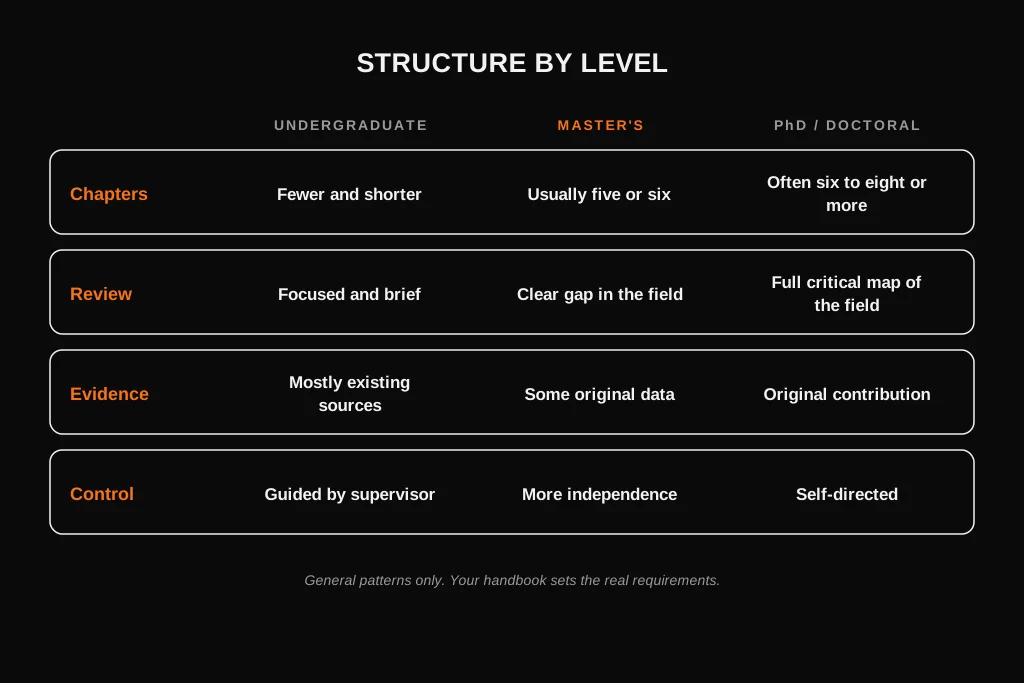
The same chapter names can mean different amounts of work depending on your level. A longer project does not just mean more words. It usually means a larger gap in the literature, more independence and a bigger contribution. The comparison below is a general pattern, so check your own handbook.
Undergraduate vs Masters Dissertation
An undergraduate dissertation shows that you can run a small, guided project, so its structure is lighter: shorter chapters, a more focused review and mostly existing sources. A master’s dissertation expects a clearer gap, more independence and often some original data or analysis, so the methodology and discussion carry more weight. If you are writing a doctoral dissertation, expect further chapters, a full critical map of the field and a clear original contribution.
In practice, the biggest differences are in the literature review and the methodology. A master’s student is expected to explain why a gap exists and defend the chosen approach against alternatives, while an undergraduate is usually asked to show that the approach is sensible and carried out carefully.
Tip: Ask for the marking criteria for your level and write each chapter against those descriptors.
Dissertation vs Thesis
Dissertation vs thesis is mostly a question of country. According to the University of Essex library, the terms are often used interchangeably, and in the UK a dissertation usually means undergraduate or taught master’s work while a thesis means doctoral research. Usage in the United States is the reverse. The structure is usually similar either way, so use whichever word your own department uses. In emails to your supervisor, copy the term printed in your course handbook, and avoid assuming that an online guide from another country uses the same word the way you do. The label changes. The need for a clear question, a method and an argument does not.
Planning Your Structure Before You Draft
Structure is easiest to fix on paper, before you have written thousands of words that depend on it. Three early decisions shape the whole plan, and each one affects how your chapters will look. Making them deliberately saves you from restructuring in the final weeks, which is when most students discover that a chapter does not fit.
How to Choose a Dissertation Topic
A good topic is narrow enough to answer in your word limit and wide enough to find sources. It matters for structure because the question decides your chapters. A comparative question needs two review sections. A question that needs new data needs a full methodology. Choose a topic whose chapters you can already picture.
Before you commit, check three practical things: whether enough sources exist, whether you can collect the evidence within your time and ethics limits, and whether your supervisor knows the area well enough to guide you.
Tip: Try sketching the six chapter titles for your topic in five minutes. If you cannot, the topic is probably still too broad or too vague.
How to Write a Dissertation Proposal
A dissertation proposal is a short plan that sets out your question, background, method, timeline and key sources. It is effectively your structure in miniature, so a good proposal already names each chapter and what it will do. Many departments ask for approval before you begin, and supervisors often use the proposal to suggest changes to scope.
A strong proposal is specific about its sources, sample and dates. Supervisors often ask for a narrower question or a clearer method, so treat that request as help rather than rejection. The proposal also becomes your checklist later, when the project starts to feel too large to hold in your head.
Tip: Reuse the proposal headings as your first chapter plan, and update them as your project evolves.
How Long Should a Dissertation Be?
Length changes how you divide your chapters, so plan it early. Commonly cited ranges are roughly 8,000 to 15,000 words for undergraduates, 12,000 to 50,000 for master’s students and 70,000 to 100,000 for doctoral dissertations, though this varies by university and field. One UK university’s dissertation handbook describes a 30-credit undergraduate dissertation as broadly an 8,000 to 10,000 word project, and notes that the count normally excludes reference lists and appendices.
A simple way to apply the limit is to turn it into chapter targets. A short dissertation may give the literature review about a quarter of the words, while a data-heavy project may give more to the methodology and findings. Treat any split as a planning guide, not a rule, and confirm with your supervisor.
Tip: Divide your word limit between chapters before you start drafting, and revisit the split after your first full draft.
An Annotated Sample Table of Contents
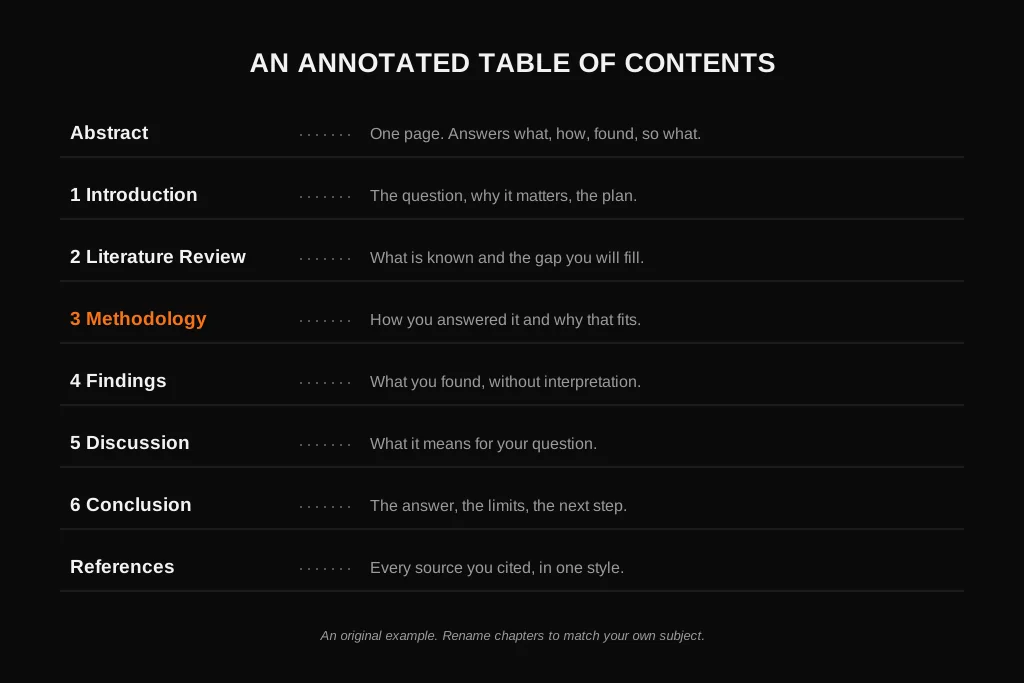
Below is an original example, written for this post, for a social science dissertation. Use it to see what each heading must achieve, then rename the chapters to suit your subject.
| Heading | What it must achieve |
| Abstract | Summarize the question, method, findings and conclusion in one page |
| 1. Introduction | State the question, why it matters, the scope and the plan |
| 2. Literature Review | Show what is known, compare sources and end with a clear gap |
| 3. Methodology | Explain and justify how you answered the question |
| 4. Findings | Report what you found without interpretation |
| 5. Discussion | Explain what the findings mean and answer the question |
| 6. Conclusion | Give the answer, state the limits and suggest next steps |
| References | List every source you cited in one consistent style |
| Appendices | Hold supporting material that would interrupt a chapter |
Making Chapters Connect: Openers and Handovers
Students often have all the right chapters but still get feedback that the dissertation feels disconnected. The fix is usually small. Give every chapter an opener and a handover. The opener tells the reader what the chapter will do. The handover tells them what it achieved and what comes next.
A simple pattern works in almost any subject. Open with one sentence that names the chapter’s task, such as “This chapter reviews the research on a topic in order to identify a gap.” Close with a short summary and one sentence that points forward, such as “This gap leads to the method described in the next chapter.” These two sentences take a minute to write and make a clear difference to how a reader experiences your argument. They also help you notice a chapter that does not know what it is for.
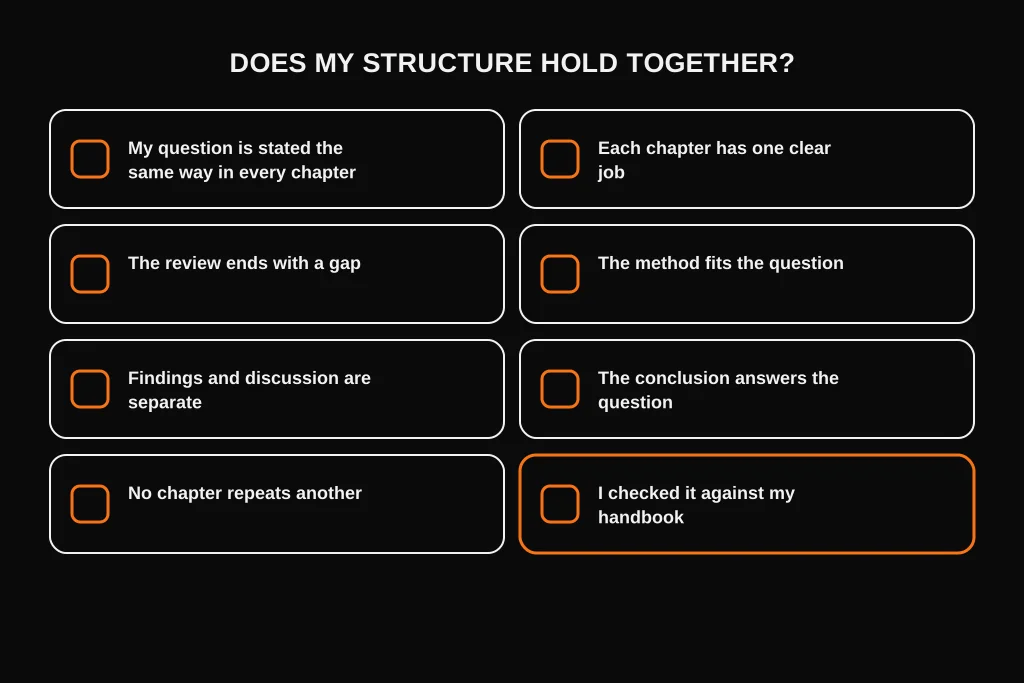
Does Your Structure Hold Together? An Eight-Question Check
Before you commit to a plan, run it through these questions. Answer each one yes or no, and fix any no before you draft.
- Is my research question worded the same way in every chapter?
- Does each chapter have one clear job?
- Does my literature review end with a gap?
- Does my method fit my question?
- Are my findings and discussion separate, unless my field combines them?
- Does my conclusion answer the question I asked in my introduction?
- Does any chapter repeat another?
- Have I compared my plan with my department’s guidelines?
Real Structure Problems Students Face and How to Solve Them
“My department’s structure looks different from every online guide.” This is normal, and your department wins. Online guides describe common models. Your handbook, template and past dissertations describe the model you are marked against. Use guides to understand why a part exists, and your department to decide how to arrange it.
“My chapters feel like separate essays.” Return to the golden thread. Write one sentence per chapter that mentions your research question, then add an opener and a handover to each chapter. If one chapter still stands alone, it may need merging or cutting.
“I do not know where to put background information.” Keep brief background in the introduction and put the critical discussion of research in the literature review. Technical details about your approach go in the methodology, and bulky supporting material goes in an appendix.
“My findings do not match my plan.” Change the plan, not the findings. Report what you found, then use the discussion to explain the gap between expectation and result. Examiners usually reward an honest, well-explained surprise over a neat result that was forced.
Common Dissertation Structure Mistakes and Fixes
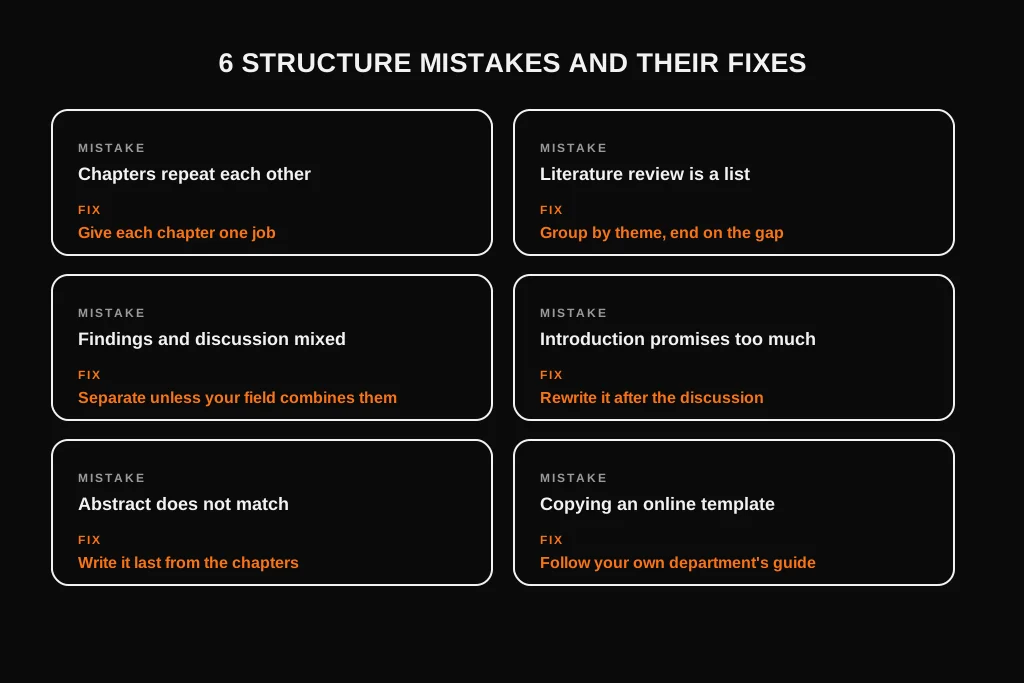
These six problems turn up in almost every draft. Most are easy to fix once you notice them.
- Chapters repeat each other. Give every chapter one job and move repeated material to the place it belongs.
- The literature review is a list. Group sources by theme and end on the gap.
- Findings and discussion are mixed. Separate them unless your field combines them.
- The introduction promises too much. Rewrite it after the discussion so it matches what you delivered.
- The abstract does not match the chapters. Write it last, from the finished chapters.
- An online template replaces your guidelines. Follow your own department’s guide first, and use general templates only to fill gaps.
Ask Your Supervisor Before You Draft
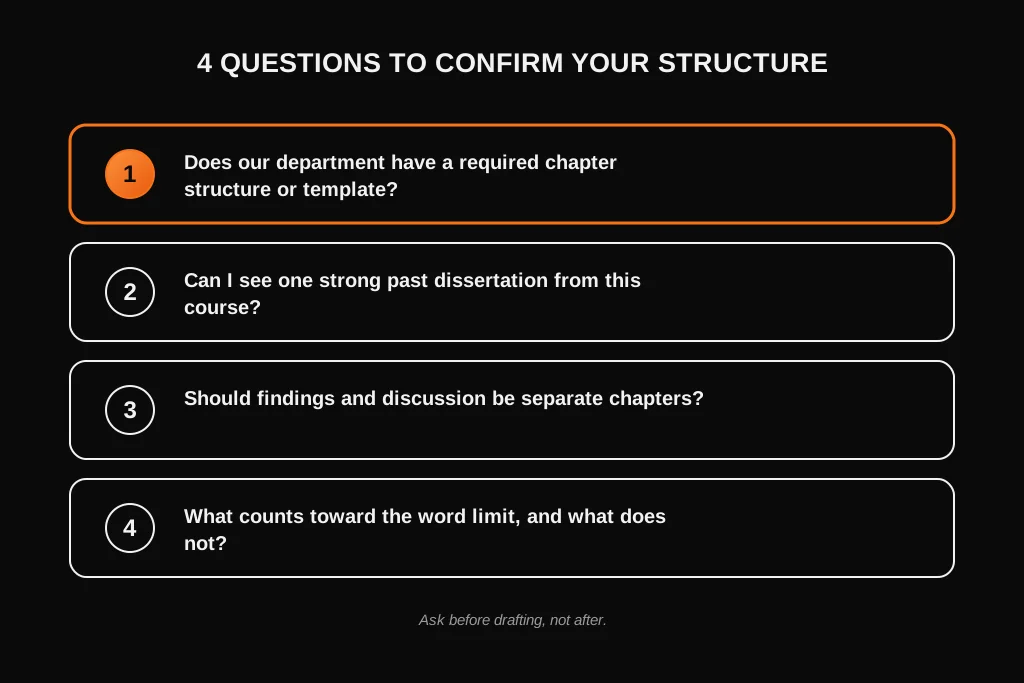
Structure rules differ between departments, and your supervisor is the fastest way to find out what yours are. Bring a short list of questions to your first planning meeting. Our guide to how to write a dissertation includes a longer set of questions for every meeting, but these four are the ones that settle structure.
- Does our department have a required chapter structure or template?
- Can I see one strong past dissertation from this course?
- Should findings and discussion be separate chapters?
- What counts toward the word limit, and what does not?
Ask these before drafting, not after. A five-minute answer now can save you a week of restructuring later.
How EssaysHelper Can Help You
Planning a structure on your own can feel like guessing what your department wants. EssaysHelper can support you at each point without taking over your work:
- Reviewing your chapter plan against your department’s guidelines.
- Giving feedback on whether your chapters connect to one research question.
- Editing drafts for clarity, flow and consistent formatting.
- Helping you build a realistic schedule from your deadline.
If you are stuck on a particular chapter, send us your question and your deadline and we will point you to the quickest next step.
Frequently Asked Questions
What is the standard structure of a dissertation?
Most dissertations have front matter, a main body and back matter. The main body usually runs from introduction and literature review to methodology, findings, discussion and conclusion. Exact names vary by subject, so check your department’s guidelines.
How many chapters should a dissertation have?
Many dissertations have five or six main chapters. Humanities dissertations often use several thematic chapters instead, and doctoral dissertations often have more. Your department and supervisor decide the final number.
What order should the parts of a dissertation go in?
The reading order is title page, abstract, acknowledgements, contents, then the chapters, references and appendices. You do not have to write them in that order, and many students draft the introduction late.
Where does the abstract go in a dissertation?
The abstract usually comes straight after the title page and before the acknowledgements and contents. It is written last, even though it appears first. Check your university’s template for the exact position.
Do I need a separate findings and discussion chapter?
In many social science and science dissertations, yes. Findings report results and discussion interprets them. Some humanities and professional dissertations combine them, so confirm what your department expects.
Is the dissertation structure different for a master’s?
The chapter names are often similar, but a master’s dissertation expects a clearer gap, more independence and deeper analysis than an undergraduate one. Doctoral work goes further, with more chapters and an original contribution.
What is the difference between a dissertation and a thesis structure?
The structure is usually similar. The difference is mostly the word and the level, which switches between the UK and the US. Use the term your own department uses, and follow its structure guide.
Should the literature review come before the methodology?
In most dissertations, yes. The review shows the gap, and the methodology explains how you will address it. Some fields blend the two or place background in the introduction, so follow your department’s model.
What goes in the appendices of a dissertation?
Appendices hold supporting material such as survey questions, interview guides, consent forms and extra tables. The main text should make sense without them. Check whether your word count includes appendices.
Can I change my dissertation structure after I start writing?
Yes, and many students do. It is normal to reorder or merge chapters as your findings become clear. Tell your supervisor about major changes, and make sure the research question still runs through every chapter.
Final Thoughts
A clear dissertation structure is not about following a template. It is about giving a reader a path from your question to your answer, with each part doing one job. Know your three zones, keep one thread through every chapter, write in the order that suits you, and test your plan against the checklist and your department’s guidelines. When a chapter feels stuck, return to your research question and ask what that chapter owes it. The answer is usually the next sentence you need to write.