
If you have ever looked at a DBQ essay prompt and thought, “What exactly am I supposed to do with all these documents?”, you are not alone. A DBQ essay can feel confusing at first because it is not just a normal essay where you write what you already know. It asks you to read documents, understand the question, build an argument, use evidence, and explain why that evidence matters.
So, what is a DBQ essay? A DBQ essay is a document-based essay where you answer a question using the documents provided to you, your own knowledge of the topic, and clear historical reasoning. It is common in history classes, especially AP History courses, but the same skills can also appear in college-level writing, source analysis assignments, and academic essays.
This guide will explain the DBQ essay meaning in simple words. You will learn the DBQ essay format, structure, writing steps, thesis examples, sample paragraph, common mistakes, and a reusable DBQ essay template. If you need extra writing support while learning essay structure, Essay Helper can also be a useful place to explore academic writing guidance.
What Is a DBQ Essay?
A DBQ essay is an essay that answers a Document-Based Question. The word DBQ stands for “Document-Based Question.” In this type of essay, you are given a question or prompt and a set of documents. These documents may include letters, speeches, newspaper extracts, maps, charts, images, political cartoons, diary entries, government records, or other historical sources.
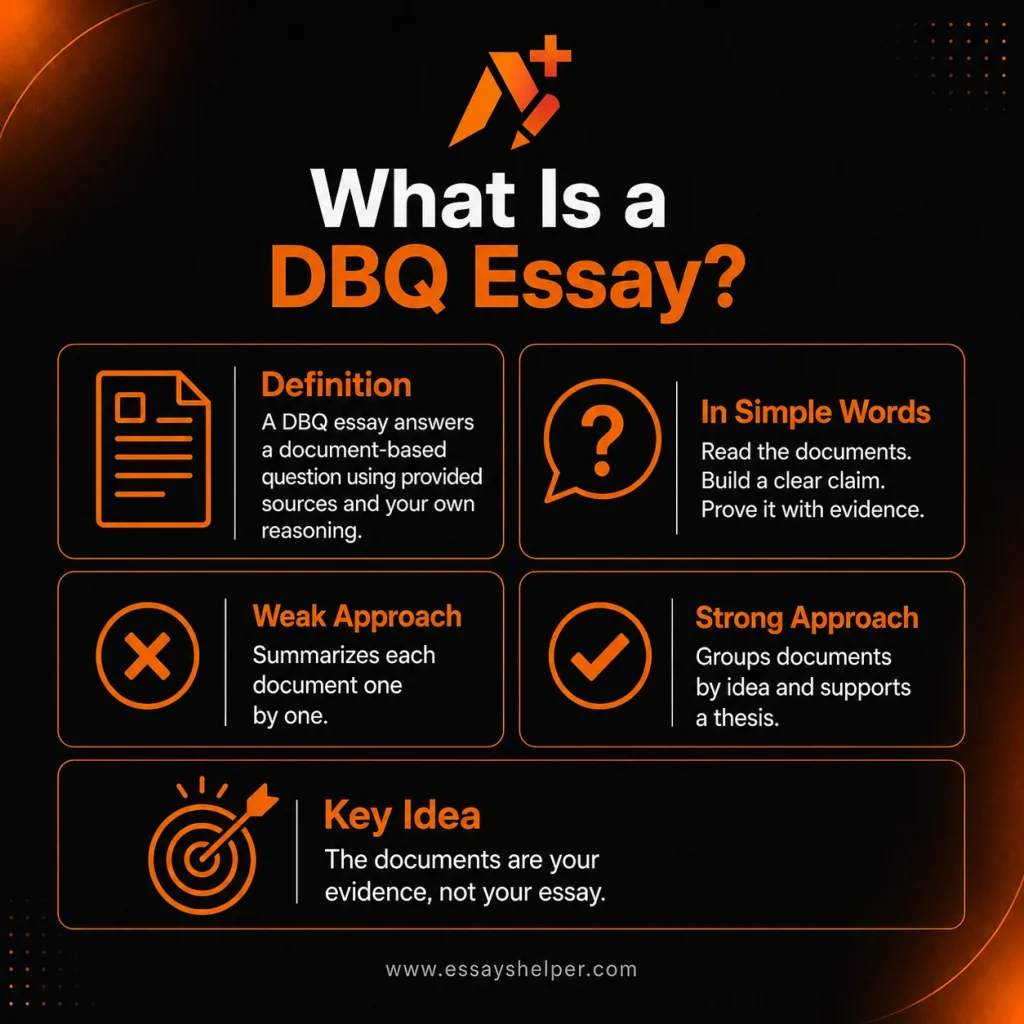
Your job is not simply to summarize each document. Your job is to use the documents as evidence to support an argument.
For example, a DBQ prompt may ask:
“To what extent did industrialization change the lives of workers in the nineteenth century?”
You may then receive several documents showing factory conditions, wages, worker complaints, government reports, and images of urban life. A weak DBQ essay would describe each document one by one. A strong DBQ essay would make an argument, group the documents by ideas, and explain how the evidence proves the argument.
A DBQ essay usually tests three main skills:
- Can you understand the prompt?
- Can you use documents as evidence?
- Can you build a clear argument instead of only describing information?
In AP U.S. History and AP World History, the College Board states that the DBQ gives students seven documents and asks them to assess written, quantitative, or visual materials as historical evidence while developing an argument supported by historical analysis. The DBQ is also worth 25% of the exam score in these AP History exams.
DBQ Essay Meaning in Simple Words
In simple words, a DBQ essay is an argument essay based on documents.
Think of it like this: the documents are not the essay. They are the evidence you use inside the essay.
A normal essay might ask you to explain a topic using your own knowledge and research. A DBQ essay gives you some of the research already, then asks you to interpret it. That means you need to read the documents carefully, decide what they show, and connect them to your answer.
For example, if the question asks whether a revolution was caused more by economic problems or political ideas, you should not just write:
“Document 1 says taxes were high. Document 2 says people wanted rights. Document 3 talks about government power.”
That is only summary.
A better DBQ response would say:
“Although political ideas influenced revolutionary thinking, economic pressure was the stronger cause because rising taxes, food shortages, and unequal financial burdens created immediate anger among ordinary citizens.”
Then you would use the documents to prove that point.
This is why a DBQ essay is close to a research essay, but it has a more controlled format. You are not searching for all the sources yourself. Instead, you are analyzing the sources given to you and using them to support a focused answer.
Why DBQ Essays Are Important
DBQ essays are important because they teach students how to think like historians. In history, it is not enough to memorize dates and events. You also need to understand why events happened, how people responded, and what different sources reveal about the past.
A DBQ essay helps students practice:
- Historical argument building
- Source evaluation
- Critical thinking
- Evidence-based writing
- Contextualization
- Cause and effect analysis
- Comparison
- Continuity and change over time
These skills are useful beyond history exams. In college and university, students are often asked to evaluate sources, compare viewpoints, and write arguments based on evidence. That is why learning how to write a DBQ essay can also improve your general academic writing.
A DBQ is also useful because it stops students from relying only on memorization. Instead of asking, “Can you remember everything about this topic?”, it asks, “Can you use evidence well?” This makes the essay more analytical.
If you already understand how a critical essay works, a DBQ essay will feel familiar. Both require you to evaluate information, make a claim, and support that claim with evidence. The difference is that a DBQ focuses heavily on historical documents and source interpretation.
How Is a DBQ Essay Different From a Normal Essay?
A DBQ essay is different from a normal essay because the evidence is mostly provided to you. In a standard essay, you may need to research books, articles, websites, or journals. In a DBQ, you receive a packet of documents and must use them in your response.
Another difference is timing. In many exam settings, especially AP History, students have limited time to read, plan, and write. This means DBQ writing requires quick thinking and clear organization.
A DBQ essay also expects you to analyze the source itself. You may need to think about:
- Who created the document?
- When was it created?
- Why was it created?
- Who was the intended audience?
- What point of view does the author have?
- What historical context shaped the document?
This type of analysis is often called sourcing. It helps you move beyond summary and show that you understand the document as historical evidence.
For example, a government speech, a worker’s diary, and a newspaper cartoon may all discuss the same event, but they may present it differently. A good DBQ essay notices those differences and explains why they matter.
DBQ Essay Format
The DBQ essay format usually follows a clear academic essay structure. While teachers and exams may have slightly different requirements, most DBQ essays include the following parts:
- Introduction
- Contextualization
- Thesis statement
- Body paragraphs
- Document evidence
- Outside evidence
- Source analysis
- Conclusion
The introduction should introduce the broader historical situation and answer the prompt with a clear thesis. The body paragraphs should each focus on one main idea. The conclusion should briefly restate the argument and show why it matters.
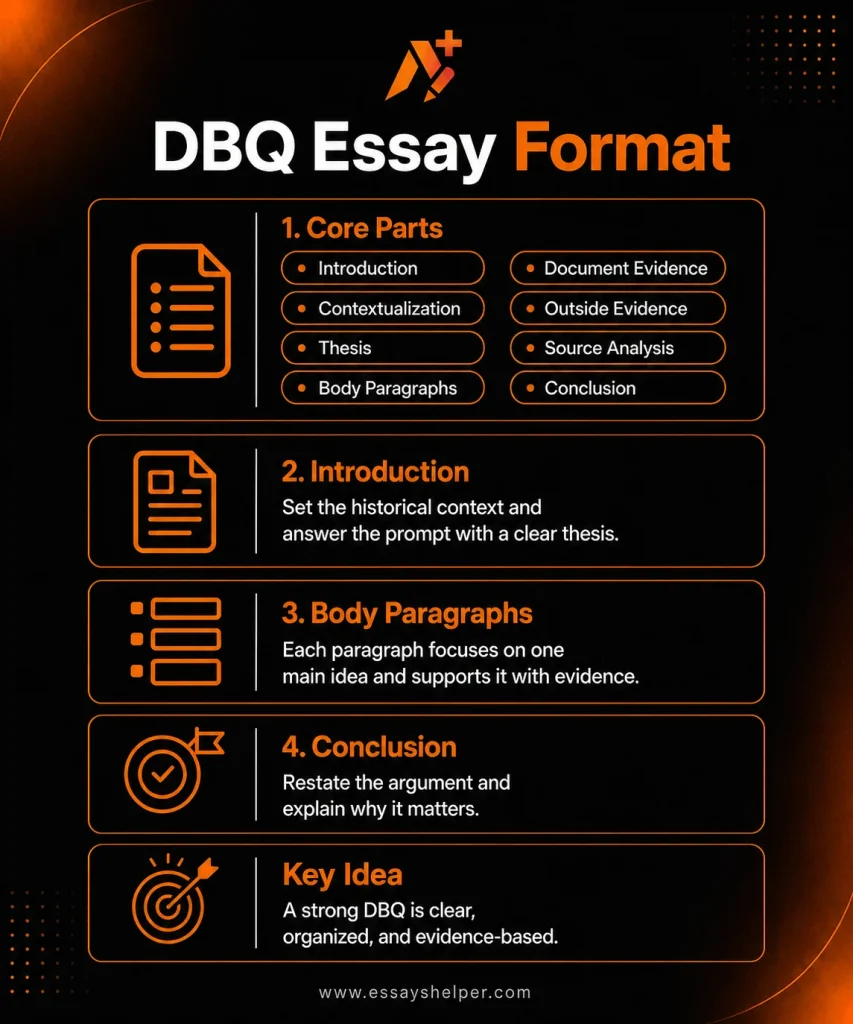
A DBQ essay does not have to be overly complicated. In fact, the best DBQ essays are usually clear, organized, and focused. The goal is not to use fancy language. The goal is to prove your argument using documents and analysis.
Students who struggle with structure can also look at different essay formats to understand how introductions, body paragraphs, evidence, and conclusions work across different academic essay types.
Basic DBQ Essay Structure
A strong DBQ essay structure usually looks like this:
Introduction
The introduction should give background information and lead into your thesis. Do not begin by listing the documents. Instead, start with the historical context.
For example:
“In the nineteenth century, industrialization changed the way goods were produced, where people lived, and how workers experienced daily life. As factories expanded, many workers faced long hours, low wages, and unsafe conditions. These changes created new economic opportunities, but they also caused serious social problems.”
After this context, you should write your thesis.
Thesis Statement
The thesis is the main argument of your DBQ essay. It should directly answer the prompt and give a clear line of reasoning.
A thesis should not be too vague.
Weak thesis:
“Industrialization changed society in many ways.”
Strong thesis:
“Industrialization transformed nineteenth-century society by increasing factory production and urban growth, but it also worsened working conditions and widened social inequality.”
The strong thesis is better because it gives a clear position and explains the main ideas that the essay will discuss.
Body Paragraphs
Each body paragraph should focus on one part of your argument. You should not organize the essay by writing one paragraph for Document 1, one paragraph for Document 2, and one paragraph for Document 3. That usually becomes a summary.
Instead, group documents by theme.
For example:
Body paragraph 1: Economic change
Body paragraph 2: Working conditions
Body paragraph 3: Social reform and resistance
Each paragraph should include a topic sentence, document evidence, explanation, and analysis.
Document Evidence
Document evidence means using the documents to support your argument. You can quote briefly, but it is usually better to paraphrase and explain.
Do not just drop a document into the paragraph. Explain what it shows and why it supports your thesis.
Weak use of evidence:
“Document 2 says workers had long hours.”
Better use of evidence:
“Document 2 shows that factory workers often worked extremely long hours, which supports the argument that industrialization increased production at the cost of worker well-being.”
Outside Evidence
Outside evidence is relevant historical knowledge that is not found directly in the documents. It shows that you understand the wider topic.
For example, if the documents discuss industrial working conditions, you might mention child labor laws, labor unions, the Factory Acts, or urban overcrowding, depending on the topic and course.
Outside evidence should be specific. A general statement like “Many things happened during this time” will not help much.
Source Analysis
Source analysis means explaining how the author’s point of view, purpose, audience, or historical situation affects the document.
For example:
“Because this document was written by a factory owner, it likely emphasizes the benefits of industrial production while minimizing the difficulties faced by workers.”
This shows that you are not treating every source as neutral. You are thinking about where the document came from and how that affects its message.
Conclusion
The conclusion should briefly bring the essay together. It should not introduce brand-new evidence. Instead, restate your main argument in fresh words and explain the broader importance of the topic.
A DBQ conclusion can be short, especially in an exam. A clear final paragraph is better than a long, repetitive one.
How to Write a DBQ Essay Step by Step
Writing a DBQ essay becomes much easier when you follow a process. Here is a simple step-by-step method.
Step 1: Understand the Prompt
Start by reading the prompt carefully. Look for the task words. These are words like “evaluate,” “analyze,” “compare,” “to what extent,” or “explain.”
For example, if the prompt asks “To what extent did reform movements change American society?”, you need to make a judgment. You should not just list reform movements. You need to explain how much change happened and where the limits were.
Ask yourself:
- What topic is the prompt about?
- What time period is involved?
- What skill is being tested?
- Do I need to compare, explain causes, evaluate effects, or measure change?
Understanding the prompt is the first step toward writing a focused essay.
Step 2: Read the Documents Quickly but Carefully
Next, read the documents. Do not panic if the documents look difficult. You are not expected to understand every word perfectly. Focus on the main message.
For each document, ask:
- What is the document saying?
- Who created it?
- What does it reveal about the prompt?
- Does it support or challenge my possible argument?
You can write quick notes beside each document. For example:
Doc 1: worker complaint about long hours
Doc 2: factory owner defending industry
Doc 3: chart showing urban population growth
Doc 4: reformer criticizing child labor
These short notes will help you group the documents later.
Step 3: Group the Documents by Theme
After reading the documents, group them by ideas. This is one of the most important DBQ skills.
For example, if the prompt is about industrialization, your groups might be:
- Economic growth
- Worker exploitation
- Urban problems
- Reform efforts
Grouping documents helps you build body paragraphs. It also stops your essay from becoming a document-by-document summary.
This is similar to learning how to enumerate in essay writing, where ideas must be organized clearly instead of thrown together randomly. In a DBQ essay, order matters because your reader needs to follow your argument.
Step 4: Create a Strong Thesis
Once you understand the prompt and documents, write a thesis. Your thesis should answer the question directly.
A helpful DBQ thesis formula is:
Although [opposing idea or limitation], [main argument] because [reason 1] and [reason 2].
Example:
“Although industrialization created new jobs and increased production, it had a largely negative effect on workers because it encouraged long working hours, unsafe factory conditions, and the growth of crowded industrial cities.”
This thesis is strong because it gives a clear position. It also creates a roadmap for the essay.
Step 5: Plan Before You Write
Even if you are working under time pressure, take a few minutes to plan. A short plan can save you from writing a messy essay.
Your plan may look like this:
Introduction: context plus thesis
Body 1: economic growth and factory expansion
Body 2: poor working conditions
Body 3: reform movements and worker resistance
Conclusion: overall judgment
Under each body paragraph, write which documents you will use. Also add one piece of outside evidence.
A DBQ essay becomes much easier when you know where each document belongs before you start writing.
Step 6: Write the Introduction
Your introduction should begin with context. Context means the broader historical background behind the prompt.
For example, if the essay is about the causes of the American Revolution, you might mention British imperial policies, colonial trade, taxation, and tensions after the French and Indian War.
Then write your thesis. Keep it clear and direct.
Do not begin with a broad sentence like “Since the beginning of time…” That sounds generic and wastes space. Start close to the topic.
Step 7: Use Documents as Evidence
In the body paragraphs, use documents to support your points. You do not need to quote long lines. Short references and explanations are usually better.
For example:
“Document 3, a chart showing rapid urban population growth, supports the idea that industrialization changed where people lived and worked.”
This sentence identifies the document and explains its relevance. That is stronger than simply saying, “Document 3 shows a chart.”
Step 8: Add Outside Knowledge
Outside knowledge is important because it shows that your understanding goes beyond the documents. Use specific names, laws, events, movements, or examples that relate to the prompt.
For example:
If writing about industrialization, outside evidence may include labor unions, the Factory Acts, child labor reforms, or urban sanitation problems.
If writing about the Cold War, outside evidence may include the Truman Doctrine, NATO, the Berlin Airlift, or the Cuban Missile Crisis.
Outside evidence should support your argument, not distract from it.
Step 9: Analyze Point of View, Purpose, Audience, or Context
Many students lose marks because they summarize documents but do not analyze them. To analyze a document, explain why its source matters.
You can discuss:
- Point of view: What perspective does the author have?
- Purpose: Why was the document created?
- Audience: Who was meant to read or see it?
- Context: What was happening at the time?
For example:
“The author’s purpose was to persuade lawmakers to improve factory conditions, so the document emphasizes worker suffering and uses emotional language to create support for reform.”
That is source analysis. It explains not only what the document says but also why it says it that way.
Step 10: Write a Focused Conclusion
End your DBQ essay by restating your argument in a fresh way. You can also mention the broader historical importance of the issue.
For example:
“Overall, industrialization brought major economic progress, but its benefits were uneven. The documents show that factory growth created wealth and production, while workers often experienced long hours, low wages, and unsafe conditions. This tension explains why industrialization led not only to economic change but also to social reform.”
This conclusion is clear, focused, and connected to the thesis.
DBQ Thesis Statement
The DBQ thesis statement is the backbone of the essay. It tells the reader what your argument is and how you will prove it.
A strong DBQ thesis should:
- Directly answer the prompt
- Take a clear position
- Include a line of reasoning
- Avoid vague wording
- Mention the main categories of your argument
A weak DBQ thesis only repeats the prompt or gives a general statement. A strong DBQ thesis makes a specific claim.
DBQ Thesis Example 1
Prompt:
“To what extent did the American Revolution change society in the colonies?”
Thesis:
“Although the American Revolution created important political changes by rejecting British rule and promoting republican ideas, its social impact was limited because many women, enslaved people, and poor citizens remained excluded from full equality.”
This thesis works because it gives a balanced argument. It recognizes change but also explains limits.
DBQ Thesis Example 2
Prompt:
“Evaluate the effects of industrialization on workers in the nineteenth century.”
Thesis:
“Industrialization created new employment opportunities and increased production, but it had mostly harmful effects on workers because factory labor often involved long hours, dangerous conditions, low wages, and limited protections.”
This thesis gives a clear judgment and names the main reasons.
DBQ Thesis Example 3
Prompt:
“Explain the causes of imperial expansion in the late nineteenth century.”
Thesis:
“Late nineteenth-century imperial expansion was driven by economic competition, nationalist ambition, and beliefs in cultural superiority, as industrial powers searched for raw materials, markets, and global influence.”
This thesis is specific and organized. It sets up body paragraphs on economics, nationalism, and ideology.
DBQ Essay Example
Here is a simple DBQ essay example. This is not based on an official exam. It is an original sample to show how a DBQ essay can be organized.
Sample DBQ Prompt
“Evaluate the effects of industrialization on urban workers in the nineteenth century.”
Sample Documents
Document 1: A factory worker’s diary describing long hours and exhaustion.
Document 2: A factory owner’s speech arguing that factories created jobs and national wealth.
Document 3: A chart showing rapid population growth in industrial cities.
Document 4: A reformer’s report describing child labor and unsafe conditions.
Document 5: A newspaper article supporting labor unions.
Sample DBQ Essay
“During the nineteenth century, industrialization changed the way goods were produced and how people lived. Instead of working mainly in small workshops or rural settings, many people moved to cities and worked in factories. This created new jobs and helped economies grow, but it also created serious problems for urban workers. Although industrialization increased employment and production, it had mostly negative effects on urban workers because it led to harsh working conditions, overcrowded cities, and demands for labor reform.
One major effect of industrialization was the rise of difficult factory work. Many workers faced long hours, repetitive tasks, and unsafe conditions. Document 1, a factory worker’s diary, describes exhaustion after long shifts, showing that industrial labor placed heavy physical pressure on workers. This supports the argument that factory growth often came at the expense of worker health and comfort. Document 4 also describes child labor and dangerous factory conditions, which shows that even young workers were exposed to harsh environments. Because the reformer who wrote Document 4 wanted to expose workplace abuse, the document likely emphasizes the worst conditions, but it still provides important evidence that industrial labor needed regulation.
Industrialization also changed urban life by encouraging rapid city growth. Document 3 shows that industrial cities grew quickly as people moved closer to factories. This supports the idea that industrialization did not only change work but also changed where people lived. Rapid urban growth often caused overcrowding, poor sanitation, and pressure on housing. Outside evidence such as the growth of industrial cities like Manchester in Britain shows how factory expansion could create crowded neighborhoods where working-class families lived in poor conditions. These urban problems made industrialization difficult for many workers, even if it created new economic opportunities.
At the same time, industrialization encouraged workers and reformers to demand change. Document 5 supports labor unions, showing that some workers responded to poor conditions by organizing collectively. This suggests that industrialization helped create a new working-class political voice. Document 2, written from the point of view of a factory owner, presents industrialization as beneficial because it created jobs and wealth. However, this perspective may be limited because factory owners had an economic interest in defending the factory system. When compared with the worker diary and reform report, the owner’s argument shows that industrialization benefited employers more than many laborers.
Overall, industrialization had a major impact on urban workers. It created jobs and helped economies expand, but it also produced long hours, unsafe conditions, overcrowded cities, and social inequality. The documents show that industrialization was not simply progress. It was a complex process that created wealth while also creating new problems that workers and reformers had to challenge.”
DBQ Essay Sample Paragraph
Here is a sample DBQ body paragraph with document evidence, outside knowledge, and analysis.
Industrialization created harsh working conditions for many urban laborers. Document 1, a factory worker’s diary, describes long hours and physical exhaustion, which shows how factory labor could damage workers’ health and daily life. Document 4 also supports this point by describing child labor and unsafe machines in factories. Since Document 4 was written by a reformer trying to expose industrial problems, its purpose was likely to persuade the public or government officials to support labor laws. However, this does not make the document useless. Instead, it helps show that working conditions had become serious enough to attract public criticism. Outside evidence such as nineteenth-century factory reform movements also supports the idea that industrial labor created problems that governments and activists eventually tried to address.
This paragraph works because it does more than summarize. It makes a point, uses documents, explains them, analyzes one source, and adds outside knowledge.
If you are learning multiple types of academic writing, this evidence-based style is also useful when writing an informative essay, because both essay types require clear explanation and organized support. The difference is that a DBQ essay must go further by building an argument from historical documents.
DBQ Essay Template
Use this DBQ essay template when you need a simple structure to follow.
Introduction Template
During the period of [time period], [broader historical context]. This issue was important because [explain why the topic matters]. Although [optional counterargument or limitation], [your main argument] because [reason 1], [reason 2], and [reason 3].
Contextualization Sentence Starters
Before [main event or issue], [background event or condition] shaped the situation by…
The issue of [topic] developed during a time when…
To understand [topic], it is important to consider…
This event was connected to broader changes such as…
Thesis Sentence Starters
Although some evidence suggests [opposing view], the stronger argument is that…
The documents show that [main argument] because…
While [factor 1] played a role, [factor 2] was more significant because…
The most important effect of [event/process] was…
Body Paragraph Template
One major reason/effect/cause was [main idea]. Document [number] supports this because it shows [evidence from document]. This matters because [explain connection to thesis]. Document [number] also demonstrates [related evidence]. The point of view/purpose/audience/context of this document is important because [source analysis]. In addition, outside evidence such as [specific historical example] further supports the argument because [explanation].
Document Evidence Sentence Starters
Document 1 supports this argument by showing that…
The evidence in Document 2 suggests that…
Document 3 challenges this view because…
The image/chart/speech in Document 4 reveals…
When compared with Document 5, Document 6 shows…
Source Analysis Sentence Starters
The author’s point of view is important because…
The purpose of this document was likely to…
The intended audience affects the document because…
This document was created during [historical context], which matters because…
Because the author was [identity or role], the document may emphasize…
Outside Evidence Sentence Starters
Outside evidence that supports this argument is…
This is also shown by the historical example of…
Another event that connects to this issue is…
Beyond the documents, [specific example] shows that…
Conclusion Template
In conclusion, [restate your main argument in fresh words]. The documents show that [summarize main evidence]. Although [acknowledge complexity or limitation], the overall evidence suggests that [final judgment]. This topic is important because [broader historical meaning].
How to Use Documents Correctly in a DBQ Essay
Using documents correctly is one of the biggest challenges in DBQ writing. Many students think that mentioning a document is enough, but it is not. You need to use the document as evidence.
There are three levels of document use.
- The first level is reference. This means you mention the document. For example, “Document 2 discusses factory work.” This is basic and not very strong.
- The second level is explanation. This means you explain what the document shows. For example, “Document 2 shows that factory work involved long hours, which supports the argument that industrialization created difficult working conditions.”
- The third level is analysis. This means you explain why the document matters as a source. For example, “Because Document 2 was written by a worker, it gives a personal view of factory life and highlights the human cost of industrial production.”
A strong DBQ essay should aim for the third level whenever possible.
You can also connect documents to each other. For example, one document may show a worker’s complaint, while another shows an employer’s defense of factory work. Comparing those documents can help you show complexity.
A DBQ essay is not about using every document in the same way. It is about choosing evidence carefully and explaining it clearly.
How to Analyze a DBQ Document
To analyze a DBQ document, use the HIPP method. HIPP stands for:
- Historical context
- Intended audience
- Purpose
- Point of view
You do not always need to discuss all four. Usually, one strong source analysis is better than a weak sentence about every category.
Historical Context
Historical context means what was happening when the document was created.
Example:
“This speech was written during a period of growing labor unrest, which explains why the speaker focuses on the need for social order.”
Intended Audience
Audience means who the document was created for.
Example:
“Because the speech was directed at government officials, the author uses formal language and focuses on policy solutions.”
Purpose
Purpose means why the document was created.
Example:
“The purpose of the report was to persuade lawmakers to regulate factories, so it emphasizes dangerous working conditions.”
Point of View
Point of view means the author’s perspective or position.
Example:
“Because the author was a factory owner, he presents industrialization as beneficial and gives less attention to worker suffering.”
The University of Wisconsin-Madison Writing Center explains that strong history writing often depends on building claims from evidence rather than simply reporting information, which connects closely to DBQ writing because documents must be interpreted and used to support an argument. historical writing guidance
DBQ Essay Format for AP History
In AP History courses, DBQ essays follow a specific scoring style. You may be expected to include a thesis, contextualization, evidence from documents, outside evidence, sourcing, and complex understanding.
For example, AP U.S. History and AP World History both present students with seven documents for the DBQ and recommend one hour for the task, including a 15-minute reading period. The DBQ is listed as 25% of the exam score in both exam formats.
This does not mean every school DBQ follows the exact same scoring system. Your teacher may use a simplified rubric. However, the basic expectations are usually similar:
- Answer the question clearly
- Use documents as evidence
- Add outside knowledge
- Explain historical context
- Analyze source perspective
- Organize ideas logically
If you are writing a DBQ outside AP History, always follow your teacher’s rubric first. The format in this guide is a strong general model, but your class instructions matter most.
DBQ Essay Outline
Before writing the full essay, create a quick outline. Here is a simple DBQ essay outline you can use.
Introduction
- Historical context
- Clear thesis statement
Body Paragraph 1
- First main argument
- Document evidence
- Explanation
- Source analysis
- Outside evidence if relevant
Body Paragraph 2
- Second main argument
- Document evidence
- Explanation
- Source analysis
- Connection to thesis
Body Paragraph 3
- Third main argument or complexity
- Document evidence
- Comparison between documents
- Outside evidence
- Explanation of significance
Conclusion
- Restate argument
- Summarize main points
- Explain broader importance
This outline keeps the essay organized. It also helps you avoid the common mistake of writing about documents in random order.
Common Mistakes Students Make in DBQ Essays
Many DBQ essays lose marks not because students know nothing, but because they do not use the documents correctly. Here are the most common mistakes.
Summarizing Instead of Arguing
This is the biggest mistake. A DBQ essay should not read like a list of document summaries. You need to make an argument and use the documents to prove it.
Instead of writing:
“Document 1 says this. Document 2 says this. Document 3 says this.”
Write:
“The documents show that economic pressure was a major cause because…”
Then use the documents as support.
Writing a Weak Thesis
A vague thesis makes the whole essay weak. If your thesis only says “there were many effects,” the reader does not know what your argument is.
Make your thesis specific. Give a clear answer to the prompt.
Ignoring the Historical Context
Contextualization is important because events do not happen in isolation. If you are writing about the American Revolution, mention the wider colonial tensions. If you are writing about imperialism, mention industrialization, nationalism, and global competition.
Context helps the reader understand the bigger picture.
Using Too Many Quotes
A DBQ essay does not need long quotations. Short references are better. Your own explanation matters more than copied lines from the documents.
Use the document, but do not let the document write the essay for you.
Forgetting Outside Evidence
Documents are important, but outside evidence can strengthen your essay. Add specific knowledge from the course or topic. This shows that you understand the issue beyond the provided sources.
Not Explaining Source Bias or Purpose
Some students mention the author but do not explain why it matters.
Weak source analysis:
“The author is a worker.”
Better source analysis:
“Because the author is a worker, the document gives direct insight into factory conditions and emphasizes the physical demands of industrial labor.”
Poor Organization
A DBQ essay should be organized by ideas, not by document numbers. Group documents around themes and write paragraphs that support your thesis.
This is similar to an evaluation essay, where you need criteria, judgment, and evidence. In a DBQ, your criteria come from the prompt, and your evidence comes from the documents.
Tips to Improve Your DBQ Essay
Improving your DBQ essay takes practice, but a few habits can make a big difference.
First, always answer the prompt directly. Many students write about the general topic but forget the exact question. Keep looking back at the prompt as you write.
Second, group documents before writing. If you group documents well, your paragraphs will be stronger and more organized.
Third, write a thesis that gives a clear argument. Your thesis should not sound like a topic title. It should sound like a position.
Fourth, explain evidence after using it. Never assume the reader understands why a document matters. Tell them.
Fifth, use outside evidence carefully. Do not add random facts just to show knowledge. Add information that supports your argument.
Sixth, analyze at least a few documents deeply. Think about author, purpose, audience, and context. This will make your essay more thoughtful.
Seventh, keep your writing clear. DBQ essays do not need complicated sentences. Clear explanation is more valuable than fancy wording.
If you are also comparing DBQ writing with general academic assignments, professional academic services can help you understand structure, formatting, editing, and essay planning in a more guided way.
How Long Should a DBQ Essay Be?
The length of a DBQ essay depends on the assignment or exam. In timed exams, a DBQ essay may be around four to six paragraphs. In a take-home assignment, it may be longer and more detailed.
A basic DBQ essay usually includes:
One introduction
Two to four body paragraphs
One conclusion
The focus should be quality, not just length. A shorter essay with a clear thesis, strong evidence, and good analysis is better than a long essay that only summarizes documents.
If your teacher gives a word count, follow it. If there is no word count, focus on fully answering the prompt.
How Many Documents Should You Use in a DBQ Essay?
The number of documents you should use depends on the rubric. In many AP-style DBQs, you are expected to use several documents, often most of the set, to support your argument. However, you should always check your teacher’s instructions or exam requirements.
The important point is that you should not force documents into the essay if you do not understand them. It is better to use documents accurately and explain them well.
When using documents, remember:
Use them to support your thesis
Group them by theme
Explain their meaning
Analyze their source when possible
Connect them to outside evidence
For official AP-style expectations, students can review the College Board’s AP U.S. History exam format or AP World History exam format, depending on the course.
How to Write a DBQ Essay Introduction
A DBQ essay introduction should be short but effective. It should include historical context and a thesis.
Do not spend too much time on a long introduction. In exam writing, the body paragraphs are where you prove your argument.
A simple introduction structure is:
Context sentence
More specific background sentence
Thesis statement
Example:
“In the late nineteenth century, industrialization transformed economies by increasing factory production, expanding cities, and creating new forms of labor. However, these changes also created serious problems for workers, including long hours, low wages, and unsafe workplaces. Although industrialization created new jobs and economic growth, it had mostly negative effects on urban workers because it worsened labor conditions, increased overcrowding, and encouraged the need for reform.”
This introduction works because it gives context and answers the prompt.
How to Write DBQ Body Paragraphs
A DBQ body paragraph should focus on one main idea. Do not mix too many ideas in one paragraph.
A strong body paragraph usually follows this pattern:
Topic sentence
Document evidence
Explanation
More evidence
Source analysis
Outside evidence
Link back to thesis
Example:
“One major effect of industrialization was the worsening of working conditions. Document 1 shows that factory workers often faced long hours and exhaustion, which supports the argument that industrial growth came at a human cost. Document 4 also describes unsafe machinery and child labor, showing that factory work affected vulnerable groups as well. Since Document 4 was written by a reformer, its purpose was likely to persuade the public to support labor protections. Outside evidence such as early factory reform laws also shows that working conditions became a major social and political issue.”
This paragraph is effective because it makes one argument and supports it with documents and explanation.
How to Write a DBQ Conclusion
A DBQ conclusion does not need to be long. It should remind the reader of your main argument and show the larger meaning of your answer.
Avoid copying your thesis word for word. Restate it naturally.
Example:
“Industrialization changed urban workers’ lives in complex ways. It created jobs and supported economic growth, but the documents show that many workers faced difficult conditions, crowded cities, and limited protections. These problems explain why industrialization led not only to economic progress but also to labor reform and social criticism.”
This conclusion is short but complete. It brings the essay back to the main argument.
DBQ Essay Checklist
Before submitting your DBQ essay, use this checklist:
Did I answer the exact prompt?
Did I write a clear thesis?
Did I include historical context?
Did I group documents by theme?
Did I use documents as evidence, not just summary?
Did I explain how the evidence supports my argument?
Did I include outside evidence?
Did I analyze source point of view, purpose, audience, or context?
Did I organize the essay clearly?
Did I write a focused conclusion?
This checklist can help you catch common problems before you submit your essay.
How EssaysHelper Can Support Students With DBQ Essays
DBQ essays can be difficult because they combine reading, analysis, planning, and academic writing. Many students understand the historical topic but struggle to turn documents into a clear argument. Others know what they want to say but find it hard to structure the essay properly.
EssaysHelper can support students who need help with essay planning, structure, editing, formatting, and academic writing guidance. If you are struggling with a DBQ essay, an essay writing service can help you understand how to organize your response, improve clarity, and build stronger arguments from evidence.
This does not mean you should ignore your class instructions. Your teacher’s rubric should always come first. But getting writing guidance can help you learn how to present your ideas more clearly and avoid common mistakes.
Students who want to plan their academic support in advance can also check essay pricing to understand available options before placing an order.
FAQs About DBQ Essays
What is a DBQ essay?
A DBQ essay is a document-based essay where you answer a question using provided documents and your own knowledge. It is common in history classes and AP History exams.
What does DBQ stand for in an essay?
DBQ stands for Document-Based Question. It means the essay question must be answered by analyzing and using documents as evidence.
How do you write a DBQ essay?
To write a DBQ essay, read the prompt, analyze the documents, create a thesis, group evidence by theme, write body paragraphs, add outside evidence, and explain source perspective.
What is a good DBQ essay format?
A good DBQ essay format includes an introduction with context, a clear thesis, organized body paragraphs, document evidence, outside evidence, source analysis, and a short conclusion.
How long should a DBQ essay be?
A DBQ essay is usually four to six paragraphs in timed exams, but the length depends on your assignment. The main goal is to answer the prompt clearly with evidence and analysis.
What is a DBQ thesis example?
A DBQ thesis example is: “Although industrialization created new jobs, it had mostly negative effects on workers because it caused long hours, unsafe conditions, and crowded urban living.”
Is a DBQ essay hard?
A DBQ essay can feel hard at first because you must analyze documents and build an argument quickly. With practice, a clear structure, and a strong thesis, it becomes much easier.
Conclusion
A DBQ essay is a document-based essay that asks you to answer a question using historical documents, outside knowledge, and clear analysis. It is not enough to summarize each document. You need to make an argument, organize evidence by theme, explain why the evidence matters, and analyze the source behind the document.
The strongest DBQ essays have a clear thesis, useful context, well-organized body paragraphs, and thoughtful document analysis. Once you understand the format, the process becomes much easier. Start with the prompt, group the documents, build your thesis, and use each paragraph to prove one part of your argument.
With practice, DBQ writing becomes less confusing and more manageable. The key is to remember that the documents are not there to overwhelm you. They are there to help you build a stronger, evidence-based essay.