
A classification essay looks simple at first. You pick a topic, divide it into categories, explain each category, and finish with a conclusion. But when students actually start writing, they often get stuck.
The biggest problem is not usually the writing itself. It is choosing the right categories. Some categories overlap. Some are too broad. Some do not follow the same logic. As a result, the essay becomes confusing, repetitive, or too descriptive.
A strong classification essay helps the reader understand a topic by organizing it into clear groups. For example, instead of writing generally about “students,” you might classify students by study habits, learning styles, or time management patterns. Instead of writing randomly about “social media users,” you might classify them as content creators, passive scrollers, professional networkers, and trend followers.
This guide will explain what a classification essay is, how to structure it, how to choose categories, and how to write it step by step. You will also find classification essay topics, thesis statement examples, outline samples, paragraph examples, and FAQs to help you write with more confidence.
If you need extra support with planning, structure, or editing, Essay Helper can also guide you through different types of academic writing without making the process feel overwhelming.
What Is a Classification Essay?
A classification essay is a type of academic essay that divides a broad subject into smaller groups or categories. These categories are based on one clear organizing principle.
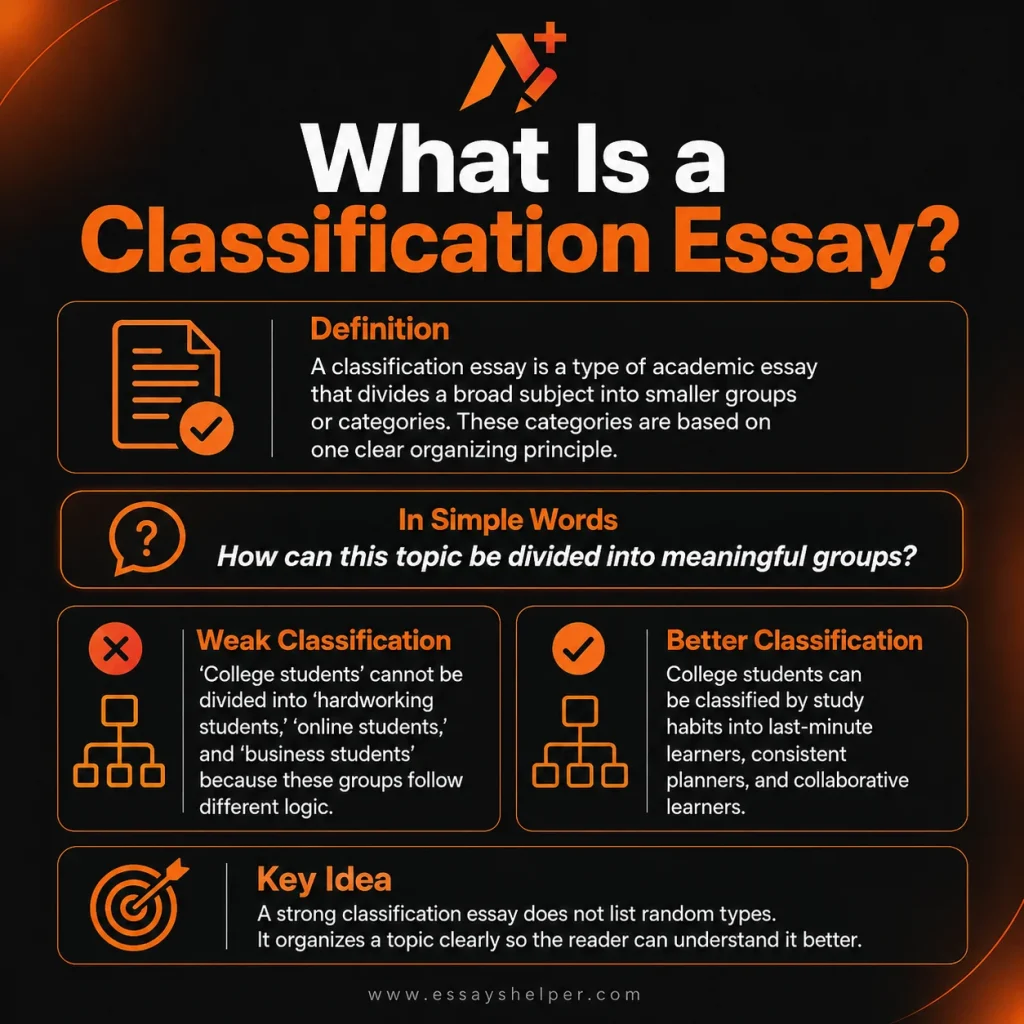
In simple words, a classification essay answers this question:
How can this topic be divided into meaningful groups?
For example, if your topic is “college students,” you cannot simply divide them into “hardworking students,” “online students,” and “business students.” These groups do not follow the same logic. One category is about effort, one is about study mode, and one is about subject area.
A better classification would be:
College students can be classified by study habits into last-minute learners, consistent planners, and collaborative learners.
Here, all categories are based on the same principle: study habits.
That is what makes a classification essay logical. It does not just list random types. It organizes a topic in a way that helps the reader understand it better.
Why Classification Essays Matter in Academic Writing
Classification essays are useful because they train students to organize information clearly. In academic writing, it is not enough to know facts. You also need to show how ideas connect, how they differ, and how they can be grouped.
This skill matters in many subjects. A business student may classify customers by buying behavior. A psychology student may classify coping mechanisms. A healthcare student may classify patient communication styles. A literature student may classify characters based on motivation or role in the story.
Classification also helps students avoid messy writing. When your categories are clear, your essay becomes easier to follow. Each paragraph has a purpose. Each example supports a specific group. The reader does not feel lost.
This is especially important because many students today write in fast-paced academic environments. College and university enrollment remains large across many countries, and students are expected to produce different forms of written assessment regularly. For example, reports on higher education trends show that undergraduate enrollment increased after several years of decline in the United States, meaning academic writing support remains highly relevant for a large student population. You can see one example of this trend in this undergraduate enrollment data report.
A classification essay helps students practice the same thinking skills they need for reports, case studies, research papers, and analytical assignments.
Classification Essay vs Other Essay Types
A classification essay is sometimes confused with other essay types because it explains a topic in detail. However, it has a specific purpose: to divide a subject into categories.
An informative essay mainly explains a topic and gives useful information. It does not always divide the topic into groups.
An explanatory essay focuses on explaining how or why something happens. It may include causes, effects, processes, or background information.
An evaluation essay judges something based on criteria. For example, it may evaluate a film, policy, book, product, or service.
A classification essay is different because its main job is organization. It takes one broad topic and breaks it into meaningful types.
For example:
Topic: Online learners
Classification essay focus: Types of online learners based on learning behavior
Explanatory essay focus: Why online learning has become popular
Evaluation essay focus: Whether online learning is effective
Informative essay focus: What online learning is and how it works
Understanding this difference helps you stay focused and avoid writing the wrong kind of essay.
Key Elements of a Good Classification Essay
A good classification essay needs more than a list of categories. It needs a clear system. Every category should fit the main topic and follow the same organizing principle.
- The first important element is a clear topic. Your topic should be broad enough to divide into groups, but not so broad that the essay becomes impossible to manage. “Technology” is too broad. “Types of technology used by university students” is more focused.
- The second element is a single classification principle. This means all categories should be based on the same idea. If you classify students by learning style, all categories should relate to learning style. Do not suddenly include categories based on age, subject, or personality unless your essay clearly explains that system.
- The third element is non-overlapping categories. A reader should understand where each example belongs. If the same example fits every category, your groups are not clear enough.
- The fourth element is balance. Each category should receive enough explanation. If one body paragraph is 300 words and another is only 60 words, the essay may feel uneven.
- The fifth element is a strong thesis statement. Your thesis should tell the reader what is being classified and what categories will be discussed.
For example:
University students can be classified into three groups based on their study habits: last-minute learners, consistent planners, and group-based learners.
This thesis is clear because it names the topic, the classification principle, and the categories.
How to Choose Classification Essay Categories
Choosing categories is the most important part of writing a classification essay. Weak categories can make the whole essay confusing, even if your writing is good.
Start by asking one question:
What is the basis for dividing this topic?
This basis is your classification principle. It could be behavior, purpose, function, style, attitude, method, level, role, or impact.
For example, if your topic is “social media users,” you can classify them in different ways:
By purpose: personal users, business users, educational users
By behavior: passive scrollers, active posters, content creators
By platform use: Instagram users, TikTok users, LinkedIn users
By impact: productive users, distracted users, brand-building users
Each option can work, but you should choose only one principle for one essay.
A weak classification would be:
Social media users include teenagers, influencers, people who scroll at night, and business pages.
This is weak because the categories are mixed. Some are based on age, some on profession, some on behavior, and some on account type.
A stronger version would be:
Social media users can be classified by purpose into entertainment users, professional users, educational users, and business users.
Now the classification is clearer because all groups are based on purpose.
If you are unsure how to organize ideas in a list or sequence, this guide on how to enumerate in essay can help you understand how to present points in a cleaner academic style.
Classification Essay Structure
A classification essay usually follows a simple academic structure. It has an introduction, body paragraphs, and a conclusion.
The introduction presents the broad topic and explains why it is worth discussing. It should also include a thesis statement that identifies the categories.
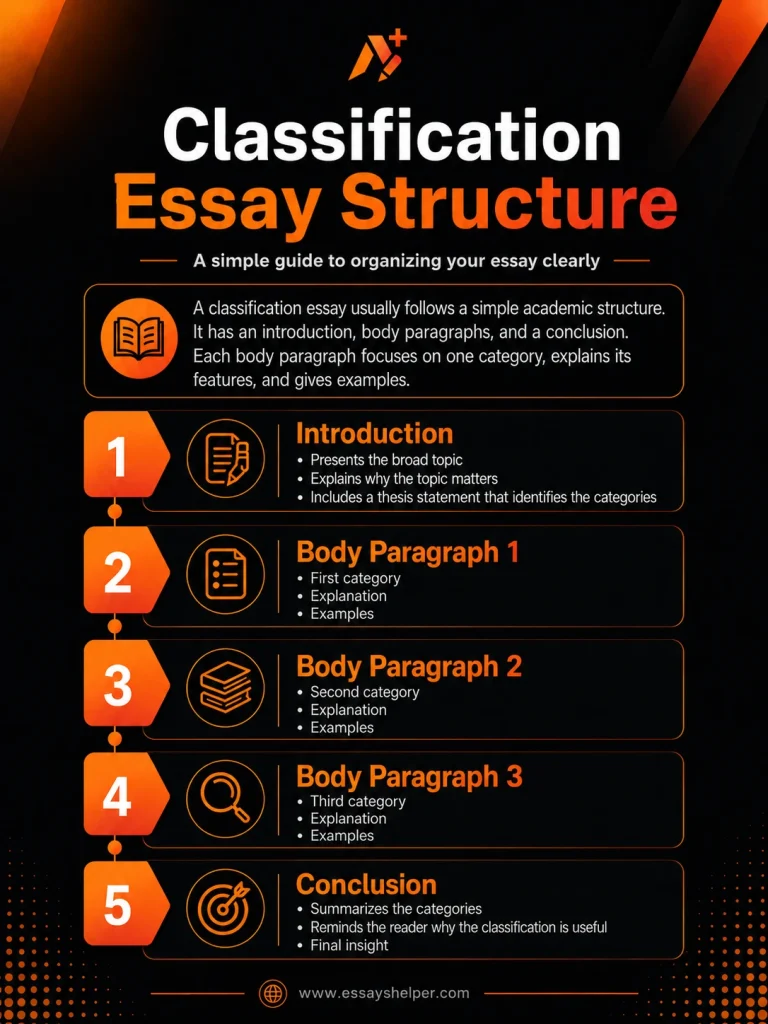
The body paragraphs explain each category one by one. Each paragraph should focus on one category only. It should define the category, explain its features, and provide examples.
The conclusion summarizes the categories and reminds the reader why the classification is useful.
This format is easy to follow and works well for most student assignments.
How to Write a Classification Essay Step by Step
Writing a classification essay becomes easier when you follow a process. Do not start with the final draft immediately. Start with planning.
Step 1: Understand the Assignment
Read the assignment brief carefully. Check the word count, topic instructions, marking criteria, and required format. Some teachers may ask for a classification and division essay, while others may simply call it a classification essay.
A classification and division essay is closely related. Division breaks a whole subject into parts, while classification groups items into categories. In most student assignments, both skills work together.
Step 2: Choose a Focused Topic
Pick a topic that can be divided into at least three useful categories. Avoid topics that are too narrow because you may not have enough to discuss.
Weak topic: Books
Better topic: Types of books students read for academic success
Weak topic: Food
Better topic: Types of eating habits among university students
Weak topic: Technology
Better topic: Types of digital tools students use for essay writing
A focused topic gives your essay direction.
Step 3: Decide the Classification Principle
Your classification principle is the rule you use to divide your topic. This is what keeps your essay logical.
For example:
Topic: University students
Principle: Study habits
Categories: last-minute learners, consistent planners, group learners
Topic: Mobile apps
Principle: Purpose
Categories: productivity apps, entertainment apps, communication apps
Topic: Teachers
Principle: Teaching style
Categories: lecture-based teachers, discussion-based teachers, activity-based teachers
Once you choose the principle, stay with it throughout the essay.
Step 4: Create Clear Categories
Your categories should be specific and easy to understand. They should not overlap too much.
For example, if you classify “types of online learners,” your categories might be:
- Independent learners
- Interactive learners
- Deadline-driven learners
These groups are clear because they describe learning behavior. However, if you add “business students” as a fourth category, it would break the logic because that category is based on subject, not behavior.
Step 5: Write a Strong Thesis Statement
Your thesis statement should appear near the end of the introduction. It should clearly mention the topic and categories.
Example:
Online learners can be classified into three main types based on their study behavior: independent learners, interactive learners, and deadline-driven learners.
This thesis tells the reader exactly what to expect.
Step 6: Prepare an Outline
An outline helps you avoid repetition. It also ensures that each category gets enough explanation.
You can use this simple format:
Introduction
Hook
Background
Thesis statement
Category 1
Definition
Main features
Example
Category 2
Definition
Main features
Example
Category 3
Definition
Main features
Example
Conclusion
Restate main idea
Summarize categories
Final thought
If you are working with multiple assignment types, it may also help to review different essay formats so you can match your structure to your academic task.
Step 7: Write the Body Paragraphs
Each body paragraph should focus on one category. Start with a topic sentence, explain the category, give examples, and connect it back to the main thesis.
Do not simply describe. Try to show why the category matters.
For example, instead of saying:
Consistent planners study every day.
You can write:
Consistent planners are students who avoid last-minute pressure by spreading their work across several days or weeks. This approach often helps them manage deadlines better, improve the quality of their drafts, and reduce academic stress.
This gives more depth.
Step 8: Revise for Clarity
After writing, check whether your categories are balanced and logical. Ask yourself:
- Do all categories follow the same principle?
- Can one example fit into more than one category?
- Is any category too weak or too broad?
- Does each paragraph support the thesis?
- Is the essay easy to follow?
Revision is where a basic essay becomes a stronger one.
Classification Essay Outline Example
Here is a simple classification essay outline on the topic “types of university students based on study habits.”
Title: Types of University Students Based on Study Habits
Introduction
Many university students attend the same classes, receive the same deadlines, and complete similar assignments. However, their study habits can be very different. Some plan early, some wait until the last moment, and others learn best through discussion.
Thesis statement: University students can be classified into three main groups based on their study habits: last-minute learners, consistent planners, and collaborative learners.
Body Paragraph 1: Last-Minute Learners
Explain that these students work close to deadlines.
Discuss pressure, urgency, and possible risks.
Give an example of a student writing an essay the night before submission.
Body Paragraph 2: Consistent Planners
Explain that these students divide work into smaller tasks.
Discuss better time management and reduced stress.
Give an example of a student preparing an outline one week before writing.
Body Paragraph 3: Collaborative Learners
Explain that these students learn through discussion and group work.
Discuss peer feedback, shared ideas, and possible dependency.
Give an example of students preparing for exams together.
Conclusion
Summarize the three types.
Explain that understanding study habits can help students improve their academic performance.
Classification Essay Thesis Statement Examples
A strong thesis statement makes the essay easier to write. It should not be too general. It should clearly show the classification system.
Here are some examples:
College students can be classified into three groups based on their study habits: last-minute learners, consistent planners, and collaborative learners.
Social media users can be divided into entertainment users, professional users, educational users, and business users based on their main purpose for using online platforms.
Teachers can be classified into lecture-based instructors, discussion-based instructors, and activity-based instructors according to their teaching style.
Online shoppers can be grouped into bargain hunters, brand loyalists, impulse buyers, and research-based buyers based on their buying behavior.
Mobile apps can be classified into productivity apps, communication apps, entertainment apps, and learning apps based on their primary function.
Essay topics can be classified into personal topics, analytical topics, argumentative topics, and research-based topics depending on the type of thinking they require.
Workplace employees can be divided into independent workers, team-oriented workers, creative problem solvers, and routine-focused workers based on their working style.
Notice that each thesis statement includes three things: the topic, the classification principle, and the categories.
Classification Essay Introduction Example
Here is a sample introduction:
University students often face similar academic expectations, but they do not all approach studying in the same way. Some students begin assignments early and follow a clear plan, while others wait until the deadline creates pressure. Many students also prefer to study with classmates because discussion helps them understand difficult ideas. These differences show that study habits can shape the way students experience academic life. University students can be classified into three main groups based on their study habits: last-minute learners, consistent planners, and collaborative learners.
This introduction works because it starts with a broad idea, narrows the focus, and ends with a clear thesis statement. The reader knows exactly what categories the essay will discuss.
Classification Essay Body Paragraph Example
Here is a sample body paragraph:
Last-minute learners are students who complete most of their academic work close to the deadline. They may understand the task earlier, but they often delay writing until pressure forces them to focus. For some students, this pressure creates energy and motivation. However, it can also lead to rushed research, weaker editing, and higher stress. For example, a student who starts a 2,000-word essay the night before submission may finish on time, but the essay may lack clear structure or strong evidence. Last-minute learners can still succeed, but they often need better planning to improve the quality of their work.
This paragraph works because it focuses on one category only. It defines the group, explains its features, gives an example, and connects the category to academic performance.
Classification Essay Conclusion Example
Here is a sample conclusion:
Study habits can strongly influence how university students manage academic pressure and complete assignments. Last-minute learners often depend on urgency, consistent planners use time management, and collaborative learners benefit from discussion and shared understanding. These categories show that students do not all learn in the same way. By understanding their own study habits, students can choose better strategies and improve both their confidence and academic results.
This conclusion works because it summarizes the categories without repeating every detail. It also gives the essay a useful final message.
Best Classification Essay Topics for Students
Choosing a good topic is easier when you think about your subject area. A strong classification essay topic should allow you to create clear categories and meaningful examples.
Education Topics
- Types of students based on study habits
- Types of teachers based on teaching style
- Types of classroom activities
- Types of online learning platforms
- Types of academic writing assignments
- Types of exam preparation methods
- Types of note-taking strategies
- Types of group project members
- Types of feedback students receive
- Types of learning styles in university
Technology Topics
- Types of mobile apps used by students
- Types of social media users
- Types of online learning tools
- Types of artificial intelligence tools in education
- Types of cybersecurity threats
- Types of digital communication methods
- Types of productivity software
- Types of online shoppers
- Types of gaming communities
- Types of technology users by behavior
Technology-related classification topics are especially useful because technology changes how students learn, communicate, and complete academic work. Research on computer science education also shows that participation in computing subjects has become an important area of educational discussion, especially as AI and digital skills become more relevant. One useful source for this topic is a computer science enrollment study, which discusses trends in student participation in computer science courses.
Social Media Topics
- Types of Instagram users
- Types of TikTok content creators
- Types of YouTube viewers
- Types of online influencers
- Types of social media marketing strategies
- Types of digital communities
- Types of online comments
- Types of social media habits among students
- Types of personal branding on social media
- Types of online communication styles
Health Topics
- Types of healthy eating habits among students
- Types of exercise routines
- Types of stress management techniques
- Types of sleep habits
- Types of healthcare communication styles
- Types of mental health support methods
- Types of diets followed by young adults
- Types of public health campaigns
- Types of patient behavior
- Types of wellness apps
Business Topics
- Types of customers based on buying behavior
- Types of leadership styles
- Types of workplace communication
- Types of entrepreneurs
- Types of marketing strategies
- Types of business risks
- Types of employee motivation
- Types of decision-making styles
- Types of online businesses
- Types of customer loyalty
Psychology Topics
- Types of motivation
- Types of personality traits
- Types of coping strategies
- Types of learning behavior
- Types of decision-making patterns
- Types of emotional responses
- Types of communication styles
- Types of stress reactions
- Types of social behavior
- Types of problem-solving approaches
Environment Topics
- Types of renewable energy sources
- Types of pollution
- Types of recycling habits
- Types of sustainable transport
- Types of climate change responses
- Types of environmental campaigns
- Types of eco-friendly products
- Types of urban green spaces
- Types of water conservation methods
- Types of waste management strategies
College Life Topics
- Types of roommates
- Types of university clubs
- Types of campus events
- Types of students in group assignments
- Types of library users
- Types of part-time jobs for students
- Types of student budgets
- Types of exam stress
- Types of study spaces
- Types of student lifestyles
Sports Topics
- Types of athletes
- Types of sports fans
- Types of team players
- Types of coaching styles
- Types of fitness routines
- Types of sports injuries
- Types of training methods
- Types of motivation in sports
- Types of football fans
- Types of competitive strategies
Entertainment Topics
- Types of movie viewers
- Types of music listeners
- Types of video game players
- Types of streaming platform users
- Types of comedy shows
- Types of fictional heroes
- Types of reality TV audiences
- Types of book readers
- Types of podcast listeners
- Types of online fan communities
Literature Topics
- Types of characters in novels
- Types of conflict in literature
- Types of narrators
- Types of heroes in fiction
- Types of villains
- Types of themes in modern literature
- Types of symbolism
- Types of literary settings
- Types of tragic characters
- Types of endings in short stories
Workplace Topics
- Types of employees
- Types of managers
- Types of workplace communication
- Types of leadership styles
- Types of teamwork behavior
- Types of workplace conflict
- Types of remote workers
- Types of professional skills
- Types of meeting participants
- Types of workplace motivation
Daily Life Topics
- Types of shoppers
- Types of drivers
- Types of travelers
- Types of friends
- Types of neighbors
- Types of eating habits
- Types of morning routines
- Types of hobbies
- Types of phone users
- Types of decision makers
Easy Classification Essay Topics
If you are new to this essay type, start with a simple topic. Easy topics are useful because the categories are familiar and examples are easier to explain.
- Types of students in a classroom
- Types of friends
- Types of teachers
- Types of social media users
- Types of movie watchers
- Types of shoppers
- Types of pets
- Types of hobbies
- Types of phone users
- Types of drivers
- Types of music listeners
- Types of readers
- Types of travelers
- Types of roommates
- Types of restaurants
These topics may look basic, but they can still become strong essays if you choose a clear classification principle.
For example, “types of friends” is too general by itself. You can improve it by writing:
- Types of friends based on emotional support
- Types of friends based on communication style
- Types of friends based on social behavior
The more focused your principle is, the better your essay will be.
Interesting Classification Essay Topics
Interesting topics usually go beyond basic categories and show more creativity. These topics can help your essay stand out.
- Types of students during exam week
- Types of people in a group chat
- Types of online learners in virtual classrooms
- Types of social media influencers
- Types of people at the gym
- Types of coffee drinkers
- Types of procrastinators
- Types of decision makers
- Types of people at airports
- Types of online reviewers
- Types of video game players
- Types of people in a library
- Types of remote workers
- Types of people who use AI tools
- Types of modern consumers
A topic becomes interesting when your categories feel familiar but insightful. For example, “types of procrastinators” can lead to a fun but academic essay if you classify them as pressure-based procrastinators, distraction-based procrastinators, and perfectionist procrastinators.
Classification Essay Examples by Subject
Classification essays can be used in almost every subject. Here are some examples to show how the same essay type works in different academic areas.
Education Example
Topic: Types of students based on learning behavior
Categories: independent learners, visual learners, collaborative learners
This essay could explain how different students process information and how each learning behavior affects academic performance.
Business Example
Topic: Types of customers based on buying behavior
Categories: bargain hunters, impulse buyers, loyal customers, research-based buyers
This essay could discuss how businesses use customer classification to improve marketing strategies.
Psychology Example
Topic: Types of coping strategies among students
Categories: problem-focused coping, emotion-focused coping, avoidance coping
This essay could explain how students respond differently to stress and academic pressure.
Technology Example
Topic: Types of AI tools used by students
Categories: writing support tools, research tools, productivity tools, revision tools
This essay could classify digital tools based on their academic purpose and discuss how students use them responsibly.
Healthcare Example
Topic: Types of patient communication styles
Categories: direct communicators, anxious communicators, passive communicators
This essay could help explain why healthcare professionals need different communication approaches.
Environment Example
Topic: Types of sustainable transport
Categories: public transport, cycling, walking, electric vehicles
This essay could explain how different transport options support environmental goals.
Common Mistakes Students Make in Classification Essays
Many classification essays lose marks because the categories are not clear. The writing may be grammatically correct, but the structure does not work.
- One common mistake is using overlapping categories. For example, if you classify students as “hardworking students,” “exam-focused students,” and “organized students,” the categories may overlap because one student can fit all three.
- Another mistake is choosing a topic that is too broad. A topic like “technology” is difficult to manage because it includes too many things. A better topic is “types of technology students use for academic writing.”
- Students also sometimes forget the classification principle. They start with one system but shift to another. For example, they may begin classifying customers by buying behavior but then include a category based on age. This weakens the logic of the essay.
- Another issue is writing description only. A classification essay should explain why each category matters. Do not just define each group. Discuss its features, examples, strengths, weaknesses, or impact.
- Uneven paragraphs are another common problem. If one category is explained in detail and another is rushed, the essay feels unbalanced.
- Some students also write weak thesis statements. A thesis like “There are many types of students” is too vague. A better thesis names the categories and classification principle.
If you feel unsure about structure, planning, or editing, using a professional essay writing service can help you understand how to organize your assignment more clearly.
Tips to Make a Classification Essay Stronger
A strong classification essay should feel organized from beginning to end. The reader should never wonder why a category is included.
Start with a focused topic. The narrower your topic, the easier it is to create meaningful categories.
Use one classification principle only. This is the rule that controls your essay. If your principle is “study habits,” do not suddenly classify students by age or subject.
Make your categories parallel. This means they should belong to the same level. For example, “visual learners,” “auditory learners,” and “kinesthetic learners” are parallel. But “visual learners,” “medical students,” and “lazy students” are not parallel.
Use examples in every body paragraph. Examples make your categories easier to understand.
Keep your tone academic but simple. You do not need complicated vocabulary to write a strong essay. Clear writing is better than confusing writing.
Use transitions between paragraphs. Phrases like “another common type,” “the second category,” and “unlike the previous group” can help guide the reader.
Revise your thesis after drafting. Sometimes your categories become clearer while writing. Make sure your final thesis matches the essay you actually wrote.
You can also use academic services if you need support with proofreading, topic selection, referencing, or improving the flow of your work.
How EssaysHelper Can Support Students
Writing a classification essay can be difficult when you are unsure how to divide your topic, build a thesis statement, or explain each category. This is where EssaysHelper can support students with practical academic guidance.
EssaysHelper is one of the reliable essay and assignment service providers for students who need help with planning, editing, proofreading, essay structure, and academic writing support. The goal is not just to complete a task, but to help students understand how a better essay should be organized.
For a classification essay, support may include choosing a focused topic, improving weak categories, creating an outline, checking paragraph balance, editing unclear sentences, and making sure the essay follows the assignment brief.
Students who are comparing support options can also review essay pricing before choosing the level of help they need.
Good academic support should make writing easier to understand. It should help you produce work that is clearer, better structured, and more aligned with your academic expectations.
FAQs About Classification Essays
What is a classification essay?
A classification essay is an academic essay that divides a broad topic into smaller categories based on one clear principle. It helps the reader understand different types, groups, or parts of a subject.
How do you write a classification essay?
To write a classification essay, choose a focused topic, decide the classification principle, create clear categories, write a thesis statement, and explain each category in a separate body paragraph with examples.
What is a good classification essay topic?
A good classification essay topic is broad enough to divide into groups but focused enough to explain clearly. Examples include types of students, types of social media users, types of learning styles, and types of online shoppers.
What is a classification essay thesis statement?
A classification essay thesis statement explains what topic is being classified and what categories will be discussed. It should also show the principle used to divide the topic.
How many categories should a classification essay have?
Most classification essays have three to four categories. This is usually enough to give detailed explanation without making the essay too broad or repetitive.
What is the difference between classification and division essay?
Classification groups different items into categories, while division breaks one whole subject into parts. Many assignments combine both because both methods help organize information clearly.
Why are examples important in a classification essay?
Examples make each category easier to understand. They show how the category works in real life and help the reader see the difference between one group and another.
Conclusion
A classification essay is all about clear organization. It takes a broad topic and divides it into meaningful categories so the reader can understand it more easily.
The most important part is choosing one classification principle and staying consistent. Your categories should be clear, balanced, and non-overlapping. Each body paragraph should explain one group with enough detail and examples.
Once you understand the structure, a classification essay becomes much easier to write. Start with a focused topic, create logical categories, build a clear thesis statement, and explain each group step by step. A well-written classification essay does not just list types. It helps the reader see a topic in a clearer and more useful way.